Decision-Making in Business: How Better Decisions Protect Momentum | MIK Law #7
Bad decisions consume capital. Slow decisions consume opportunity.
Every organisation makes decisions.
Some are strategic.
Some are operational.
Some involve capital.
Some involve people.
Some are routine.
Some are irreversible.
Some matter enormously.
Others barely matter at all.
Yet organisations frequently treat decisions as though they belong to one category.
They do not.
A minor operational choice can remain unresolved for days while several people debate it.
A high-impact decision can be rushed because urgency has overwhelmed judgment.
A reversible choice may be escalated unnecessarily.
An irreversible one may be made without sufficient challenge.
The result is not only poor decision quality.
It is poor decision architecture.
That is the premise behind MIK Law #7 — The Decision Law:
Bad decisions consume capital. Slow decisions consume opportunity.
The objective is therefore not simply to make decisions faster.
Nor is it to analyse everything more deeply.
It is to determine which decisions deserve speed and which deserve depth.
That distinction creates decision velocity.
Decisions Have Two Costs
Most people recognise the cost of a bad decision.
An investment fails.
A product underperforms.
Inventory is misallocated.
A poor hire creates disruption.
Capital is deployed incorrectly.
A customer opportunity is mishandled.
The cost eventually becomes visible. But there is another type of decision cost that is much harder to see:
the cost of not deciding.
An opportunity waits.
A customer loses patience.
A competitor moves first.
A project remains blocked.
A team waits for direction.
Capital remains idle.
A problem becomes more expensive.
Nothing may appear in the accounts under the heading Decision Delay.
But value is still being lost.
This is why decision quality must be considered alongside decision speed.
A theoretically perfect decision made after the opportunity has disappeared is not necessarily a good decision.
Decision Velocity Is Not Impulsiveness
Speed can easily be confused with decisiveness.
They are not the same.
A person who makes every decision quickly may simply be impulsive.
A person who analyses every decision deeply may simply be slow.
Decision velocity means something more disciplined.
It is the ability to:
recognise the type of decision,
understand the downside,
know how much information is enough,
identify who has authority,
and then
move at the appropriate speed.
Decision velocity therefore depends on architecture, not personality.
A strong decision system allows different decisions to move at different speeds.
The Two Variables That Change Everything
A useful starting point is to evaluate decisions using two dimensions:
IMPACT
How significant is the consequence?
and
REVERSIBILITY
How difficult is the decision to undo?
These two variables create a simple but powerful decision architecture.
A decision that is:
low impact and highly reversible
should not consume the same management attention as one that is:
high impact and difficult to reverse.
Yet many organisations do exactly that.
This is where decision friction begins.
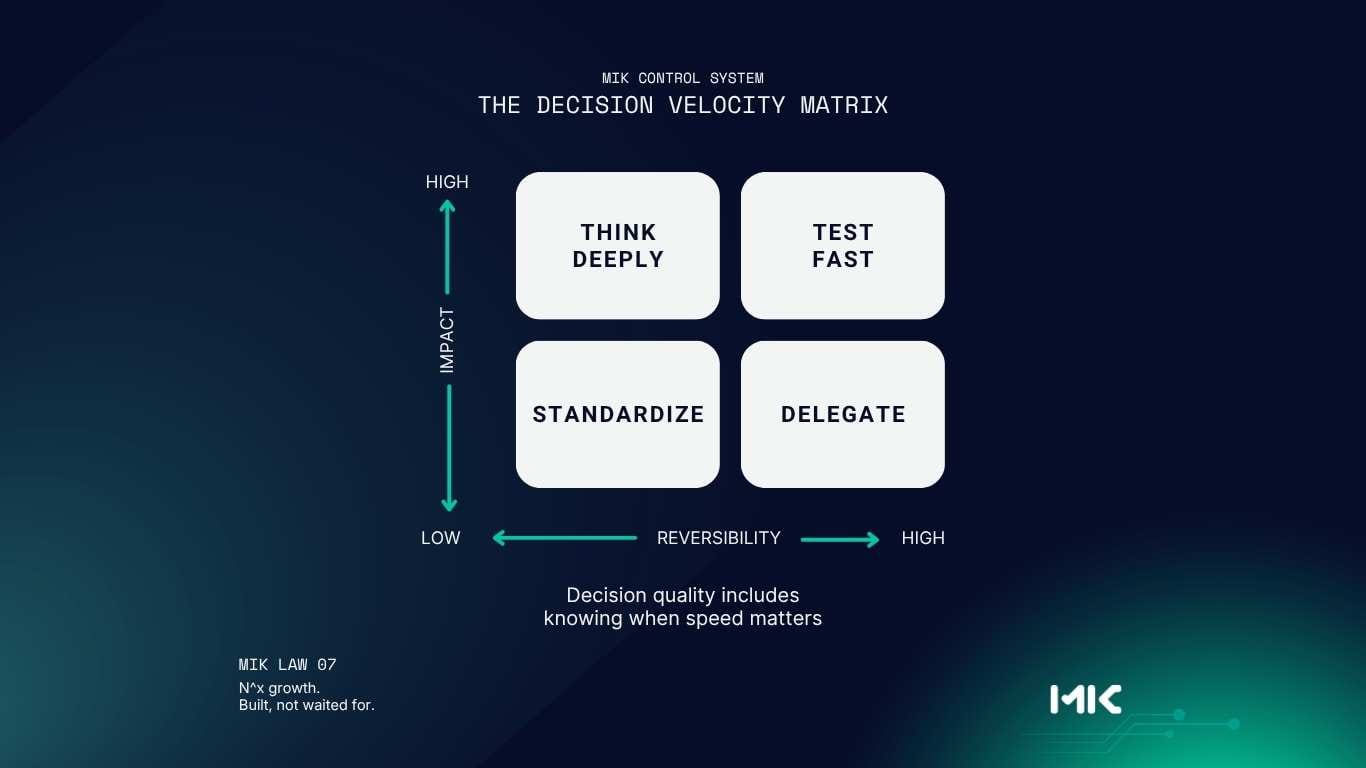
The MIK Decision Velocity Matrix
The Decision Law can be represented through four decision types.
1. HIGH IMPACT + LOW REVERSIBILITY
THINK DEEPLY
These decisions deserve care.
Examples may include:
major capital commitments,
significant acquisitions,
long-term strategic partnerships,
senior leadership appointments,
major structural changes,
or commitments carrying substantial legal or reputational exposure.
The cost of error is high.
Reversal may be expensive or impossible.
The right response is not endless analysis.
It is appropriate depth.
This usually requires:
better information,
scenario analysis,
challenge,
clear assumptions,
and explicit consideration of downside.
The objective is to reduce avoidable error before commitment.
2. HIGH IMPACT + HIGH REVERSIBILITY
TEST FAST
These decisions are strategically important but recoverable.
That changes the logic.
If the organisation can:
test,
observe,
learn,
and change course,
then experimentation becomes valuable.
Rather than debating the perfect answer for months, the organisation can sometimes design a controlled test. This produces real information. A decision that was previously theoretical becomes empirical. This is particularly powerful in:
product development,
pricing,
marketing,
technology,
process redesign,
and customer experience.
The principle is:
When reversal is cheap, learning can be faster than prediction.
3. LOW IMPACT + HIGH REVERSIBILITY
DELEGATE
These decisions should normally move quickly. If the downside is small and the choice is easy to reverse, senior management involvement may create more cost than value.
Examples might include:
routine commercial exceptions,
minor operational choices,
low-value purchases,
small process changes,
or day-to-day resource decisions.
The organisation should establish boundaries and allow people closest to the issue to act.
This creates two benefits.
The decision moves faster.
And senior attention is protected.
4. LOW IMPACT + LOW REVERSIBILITY
STANDARDISE
Some low-impact decisions are repetitive but awkward to reverse once executed. The better solution is often not repeated management judgment. It is a standard.
Define the acceptable method.
Build the control into the process.
Make exceptions visible.
Then allow routine decisions to disappear into the system.
This is where decision architecture becomes system design.
The best recurring decision is often the one the organisation no longer needs to consciously make.
Not Every Decision Deserves Equal Time
This may be the most important principle in the Decision Law.
Organisations waste enormous amounts of attention because decision time is not allocated according to decision importance.
A $500-equivalent decision may receive three meetings.
A multi-million strategic assumption may receive five minutes because it is buried inside a larger proposal.
The problem is not simply inefficient management. It is poor allocation of cognitive capital. Time spent deciding is itself an investment. And like any investment, it should be allocated according to expected value.

Strong leaders do not make every decision quickly. They know which decisions deserve speed, which deserve depth, and which should disappear into the system.
The Information Trap
Many decisions are delayed because people believe more information will eventually create certainty.
Sometimes additional information is essential. But information has diminishing returns. The first pieces may change the decision materially. Later pieces may merely make the decision-maker feel more comfortable. This creates a useful question:
What information would actually cause us to choose differently?
If the answer is:
“none of the additional information currently being requested,”
then continued analysis may no longer be improving decision quality.
It may simply be postponing commitment.
This is analysis friction.
Enough Information Is Not Complete Information
Good decisions rarely require perfect information.
Perfect information usually arrives after the decision was valuable.
The objective is therefore to identify:
the minimum sufficient information required for the type of decision being made.
For a reversible operational choice, that threshold may be low.
For a major irreversible capital decision, it should be much higher.
The standard changes with risk.
This is why decision systems must be contextual.
There is no universal rule such as:
“make decisions with 70% of the information.”
That can sound decisive while ignoring the nature of the choice.
The better principle is:
Match the information threshold to the consequence of being wrong.
The Cost of Escalation
Many organisations unintentionally slow themselves through excessive escalation.
Decisions move upward because:
authority is unclear,
people fear accountability,
policies are ambiguous,
or senior leaders have historically intervened in operational detail.
Over time, the organisation learns:
when uncertain, escalate.
This creates a bottleneck. Senior managers become decision servers for the entire organisation.
Teams wait. Issues queue. Management attention becomes consumed by increasingly small choices. The organisation may have capable people throughout it, yet decisions remain concentrated at the top.
That is not control. It is dependency. A stronger operating system defines:
who decides,
within what limits,
using what criteria,
and
what requires escalation.
This is decision architecture.
Decision Rights Create Speed
Decision rights answer a deceptively simple question:
Who has the authority to decide this?
When the answer is unclear, several behaviours emerge.
People seek informal approval.
Emails copy additional stakeholders.
Meetings grow.
Decisions become collective.
Accountability becomes blurred.
The safest response becomes delay.
Clear decision rights remove this friction.
They can define:
commercial limits,
capital thresholds,
pricing authority,
hiring authority,
operational tolerances,
risk parameters,
and escalation conditions.
The objective is not to decentralise everything.
It is to locate each decision at the lowest appropriate level with sufficient information and authority.
That is a far more scalable model.
Decisions and Accountability
Delegation without accountability creates disorder.
Control without delegation creates bottlenecks.
The balance lies in defining both:
authority to decide
and
responsibility for the consequence.
If people possess responsibility without authority, they become dependent.
If they possess authority without accountability, risk can increase.
Strong systems connect the two.
This creates ownership.
People know:
what they can decide,
what outcome they own,
and what information will make performance visible.
The result is not merely faster decisions.
It is stronger organisational confidence.
Decision Quality Is More Than Outcome
There is a subtle trap when evaluating decisions. A good outcome does not necessarily mean a good decision was made. A poor decision can occasionally produce a favourable outcome through luck.
Likewise, a rational decision based on strong information can produce a poor outcome because uncertainty exists. Decision quality should therefore be evaluated partly by the process used at the time, not only by hindsight.
Ask:
Was the objective clear?
Were the major risks understood?
Were assumptions explicit?
Was the relevant information available?
Were alternatives considered?
Was the decision made at the appropriate level?
Was the timing appropriate?
This protects organisations from learning the wrong lessons.
Otherwise, luck can become strategy.
Make Assumptions Visible
Every important decision contains assumptions.
Demand will rise.
The customer will respond.
Costs will remain within range.
Implementation will occur on time.
A market will behave as expected.
The technology will perform.
A team will adopt the change.
When assumptions remain invisible, they cannot be monitored.
A stronger decision process states them explicitly.
For example:
We are making this investment because we believe demand will remain above X and utilisation will reach Y within Z months.
Now the organisation can monitor the assumptions.
If reality changes, the decision can be revisited.
This makes decision-making adaptive rather than static.
Reversibility Creates Optionality
A powerful decision strategy is to preserve reversibility where possible. Rather than committing fully at the beginning, the organisation may be able to structure decisions in stages.
Pilot before rollout.
Lease before purchase.
Test before scaling.
Phase investment.
Use milestones.
Create break points.
Negotiate options.
This lowers the cost of being wrong. And when the cost of being wrong falls, the organisation can often move faster. This is a subtle but important idea:
Sometimes the best way to improve decision speed is to redesign the decision so it becomes easier to reverse.
That is strategic optionality.
Decisions Should Create Learning
A decision should not disappear after execution.
It should produce information.
What did we expect?
What happened?
Which assumption was correct?
Which was wrong?
What would we do differently?
Without this feedback loop, organisations can repeatedly make similar decisions without becoming better at them. This is particularly important in uncertain environments. Decision quality improves when past decisions become organisational memory. The cycle becomes:
DECIDE → ACT → OBSERVE → LEARN → IMPROVE THE NEXT DECISION
This is how judgment compounds.
The Decision Log
One simple practice can dramatically improve institutional learning:
record major decisions at the time they are made.
The record does not need to be complex.
Capture:
Decision
What did we choose?
Reason
Why?
Assumptions
What must be true?
Risks
What could go wrong?
Expected Outcome
What should happen?
Review Date
When will we know?
This creates enormous value later.
Without it, hindsight rewrites memory.
People remember assumptions differently.
The original logic disappears.
A decision log turns judgment into something the system can inspect and improve.
Decisions and the Clarity Law
Law #3 established:
NOISE → SIGNAL → PRIORITY → ACTION
Decision-making sits directly between priority and action.
Clarity determines what matters.
Decision architecture determines what to do about it.
Poor clarity creates poor decisions because the organisation may optimise for the wrong issue.
But clarity without decision creates stagnation.
At some point:
analysis must become choice.
That is the bridge.
Decisions and the Speed Law
Law #6 argued that speed comes from removing friction.
Decision latency is one of the largest forms of friction inside most organisations.
A workflow can be beautifully designed yet remain slow if it repeatedly waits for approval.
This means that improving decision architecture can accelerate multiple processes simultaneously.
One improved decision right may remove hundreds of future delays.
That is a multiplier.
It explains why decision design is not merely a leadership skill.
It is part of system design.
Decisions and the Compression Law
The Compression Law asked:
Where is wasted distance hiding inside elapsed time?
Waiting for decisions is one of the clearest examples.
Imagine a process containing:
two hours of actual work,
but four days of elapsed time.
If three of those days are spent awaiting decisions, the main compression opportunity is not in the work.
It is in the decision architecture. This is why the MIK Laws increasingly reinforce one another. A better decision system improves:
speed,
compression,
execution,
and ultimately,
system yield.
The Role of Intuition
Not every good decision can be reduced to a formula.
Experienced leaders develop pattern recognition.
They have seen similar situations.
They recognise signals quickly.
They understand contextual factors that may be difficult to quantify.
This intuition is valuable.
But intuition should not be confused with infallibility.
The best use of experience is often:
intuition generates the hypothesis;
evidence tests it.
Strong decision-makers know when their experience provides useful signal and when unfamiliar conditions demand more deliberate analysis. The objective is not to eliminate judgment.
It is to improve the architecture around judgment.
Consensus Can Slow Decisions
Consensus sounds attractive.
Everyone agrees.
Everyone feels included.
But requiring consensus for every decision can dramatically slow an organisation.
Different stakeholders have different information, incentives and risk tolerances.
Full agreement may be unnecessary.
The key distinction is between:
INPUT
and
DECISION RIGHTS
Many people may provide input.
One person may still need to decide.
This preserves breadth of perspective without allowing decision ownership to disappear.
A useful principle is:
Consult widely where useful. Decide clearly where necessary.
When Speed Is the Wrong Objective
The Decision Law is not an argument for universal acceleration.
Some decisions should be slow.
Where the consequences are:
large,
irreversible,
poorly understood,
systemic,
or difficult to contain,
deliberation is valuable.
Speed becomes dangerous when it removes necessary challenge. This reinforces the central point:
The objective is appropriate decision velocity.
Not maximum velocity.
A mature organisation does not boast that every decision is fast.
It is proud that each type of decision moves at the speed its consequences justify.
The Decision Velocity Audit
Take a set of recent decisions and ask:
How important was this decision?
How reversible was it?
How long did it take?
Who actually had authority?
How much of the information gathered changed the choice?
How much time was spent waiting rather than thinking?
Could the decision have been delegated?
Could it have been standardised?
Could it have been tested before full commitment?
Were assumptions recorded?
Was the outcome reviewed later?
Then look for a pattern.
You may discover that the organisation is:
moving too slowly on low-risk choices,
moving too quickly on high-risk commitments,
or consuming senior attention on decisions that should never have reached senior management.
That is the opportunity.
Decision-Making as an Operating Capability
Organisations often describe decision-making as though it belongs only to leaders.
But every system contains decisions.
Salespeople decide.
Technicians decide.
Managers decide.
Customers decide.
Software increasingly makes or recommends decisions.
The quality and speed of those decisions collectively influence organisational performance. This means decision-making should be designed like any other capability.
Standards.
Thresholds.
Authority.
Information.
Feedback.
Learning.
The objective is to create an organisation that becomes increasingly good at making the right kind of decision at the right level at the right speed.
That is much more powerful than relying on a few decisive personalities.
Decisions and Nˣ
The broader MIK concept of Nˣ growth depends on leverage.
Decision architecture can create leverage in several ways.
One clarified authority threshold can accelerate thousands of transactions.
One better decision rule can improve consistency across many people.
One useful dataset can improve many future choices.
One documented lesson can prevent repeated errors.
One reversible test can generate information that improves a much larger investment.
The value of a good decision system therefore extends beyond an individual choice.
It changes the productivity of future choices.
That is leverage.
The Deeper Principle
The purpose of decision architecture is not to eliminate uncertainty.
That is impossible.
It is to operate intelligently inside uncertainty.
Know which decisions matter.
Know which can be reversed.
Know what information changes the choice.
Know who has authority.
Know when to test.
Know when to deliberate.
Know when enough is enough.
And then move.
Because indecision is not neutral.
Time continues.
Markets move.
Customers decide.
Competitors act.
Conditions change.
Opportunity has a clock.
That brings us back to MIK Law #7:
Bad decisions consume capital. Slow decisions consume opportunity.
The advantage lies in knowing which decision deserves which kind of speed.
MIK LAW #7 — THE DECISION LAW
Not every decision deserves equal time.
Nˣ growth. Built, not waited for.
Thanks for reading, Imran

IMRAN KHAN
Navigating the '1-in-a-100-year' wave of change in this era of lightning-paced progress, I stand at the forefront. With a sharp focus on digital transformation, artificial intelligence, and the dynamic domains of automotive and real estate investment, my commitment lies in forging a trail toward excellence and innovation.
Insights
Stay informed with our latest press releases, stories, announcements, and industry insights.


© 2026 MIK Consultivo


Stay in touch
© 2026 MIK Consultivo
Digital Transformation
Automotive Digitalization
Follow MIK Consultivo |