Business Speed: Why Removing Friction Accelerates Execution | MIK Law #6
Speed is not rushing. Speed is removing friction.
When organisations want faster results, the instinct is usually predictable.
Push harder. Increase urgency. Set tighter deadlines. Add pressure. Ask people to move faster. Sometimes that works temporarily.
But sustainable speed rarely comes from asking the same system to operate at a higher level of intensity.
It comes from changing the system itself.
That is the premise behind MIK Law #6 — The Speed Law:
Speed is not rushing. Speed is removing friction.
The distinction matters because haste and speed can look similar from the outside.
Both involve movement.
Both can involve urgency.
Both may produce faster short-term activity.
But they are fundamentally different operating states.
Haste increases pressure.
Speed improves flow.
Faster People Do Not Automatically Create a Faster System
A process can contain extremely capable people and still move slowly. The reason is simple. Most organisational delay does not occur while somebody is actively performing the work. It occurs between actions.
Waiting for information.
Waiting for approval.
Waiting for another department.
Waiting for a customer response.
Waiting for a system update.
Waiting for a meeting.
Waiting for a decision.
Waiting because nobody is certain who owns the next step.
The individual task may take ten minutes.
The elapsed process may take three days.
This exposes one of the central ideas behind the Speed Law:
The speed of the system is not determined only by how quickly people work. It is determined by how easily work moves.
That shifts the management question.
Instead of:
How do we make people faster?
ask:
What is slowing the movement of work?
The Difference Between Speed and Urgency
Urgency is a response to time pressure.
Speed is a property of the system.
An organisation can operate in a permanent state of urgency while remaining structurally slow.
Emails are marked urgent.
Meetings are called quickly.
Managers chase actions.
Teams work late.
Escalations multiply.
Everyone feels pressure.
Yet the same delays continue to reappear.
That is not speed.
It is friction under pressure.
A fast organisation feels different.
Decisions move because authority is clear.
Information moves because systems are connected.
Work moves because ownership is visible.
Exceptions surface quickly.
Routine activities require little management intervention.
The organisation does not need constant urgency because movement is already built into the architecture.

The fastest organisations are not always the ones working hardest. They are the ones making work travel the shortest distance through the least friction.
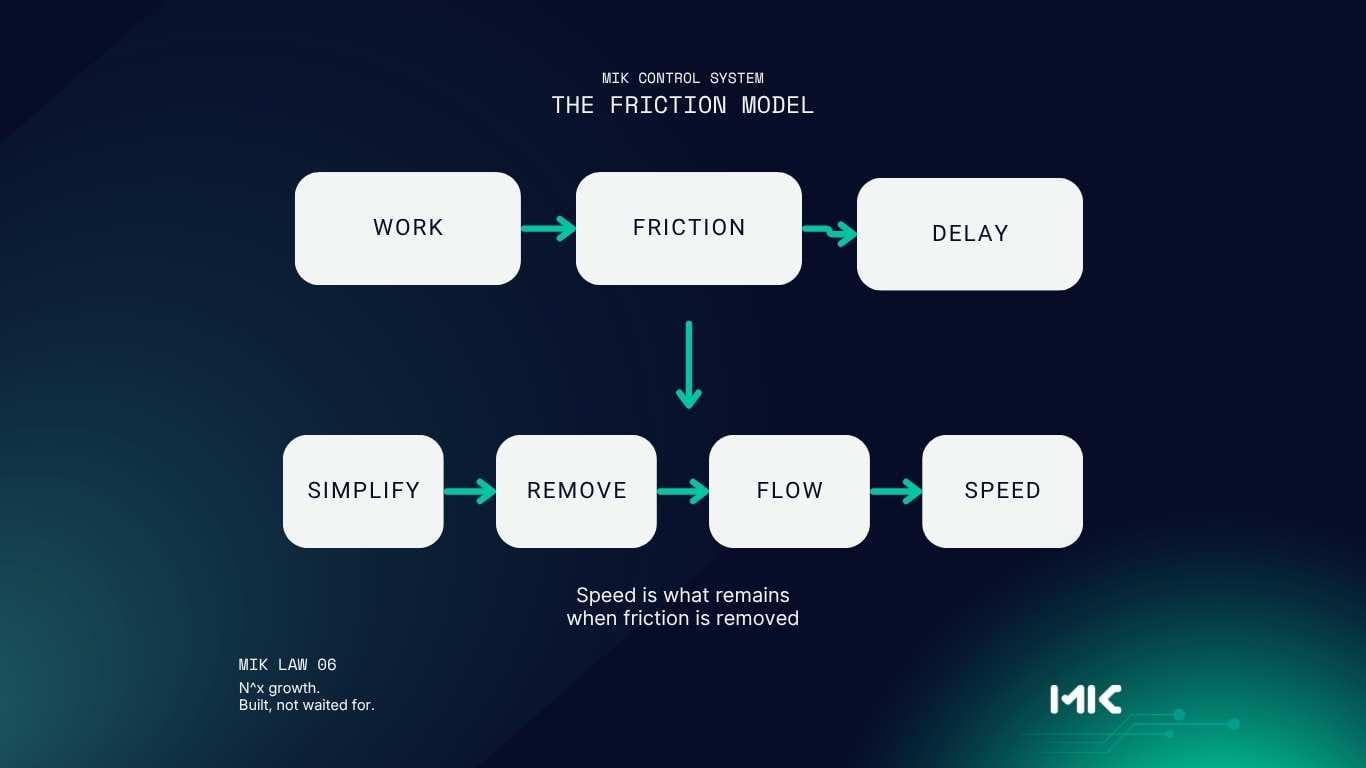
The MIK Friction Model
The Speed Law can be expressed through a simple sequence:
WORK → FRICTION → DELAY
And the response:
SIMPLIFY → REMOVE → FLOW → SPEED
The important word is flow.
Speed is an outcome of flow.
When work moves smoothly through a system, velocity increases naturally.
When work repeatedly encounters resistance, the organisation compensates through effort.
The objective is not to make people run faster through a badly designed process.
It is to redesign the process so they no longer have to.
What Is Friction?
Friction is anything that consumes time or energy without proportionately improving the outcome.
Some friction is obvious.
Duplicated approvals.
Manual re-entry of information.
Unnecessary meetings.
Repeated requests for the same data.
Excessive handoffs.
Unclear responsibility.
Other forms are less visible.
Ambiguous priorities.
Poorly designed incentives.
Systems that do not communicate.
Different teams using different definitions.
Information arriving too late to affect a decision.
Senior leaders becoming approval points for routine matters.
Each may appear minor.
But repeated across hundreds or thousands of transactions, small friction becomes structural drag.
1. Decision Friction
One of the largest sources of organisational delay is decision latency. A task reaches a point where somebody needs to decide. But:
authority is unclear,
the criteria are undefined,
information is incomplete,
or the decision-maker is unavailable.
The work stops.
Nothing visible may be happening, but time continues passing.
This is why clear decision rights can produce dramatic increases in speed.
A useful operating design separates decisions into categories.
Routine decisions should be embedded in standards.
Reversible decisions should often be made quickly.
High-impact irreversible decisions deserve deeper analysis.
Exceptions should move through a clearly defined escalation path.
Without this architecture, every decision begins to look unique.
And unique decisions consume time.
2. Information Friction
Work slows when information has to be searched for, reconstructed or repeatedly requested.
Consider a process where the required information exists in several systems.
One employee checks one platform.
Another checks a spreadsheet.
A manager asks for an update.
Somebody sends a screenshot.
A second person manually reconciles the numbers.
The underlying work may be simple.
The information architecture is not.
Better information flow can therefore create speed without changing the underlying task at all.
The principle is straightforward:
Information should arrive where the decision occurs, before the decision is required.
When that happens, latency falls.
3. Handoff Friction
Every transfer of work creates potential delay.
From sales to operations.
From operations to finance.
From service to parts.
From one manager to another.
From one software platform to another.
Each handoff introduces several risks:
context may be lost,
information may be incomplete,
priority may change,
ownership may become unclear,
and the receiving person may not know that action is required.
This does not mean handoffs should disappear entirely.
Complex organisations require specialisation.
But every handoff should justify its existence.
A useful question is:
Does this transfer add expertise, control or value—or merely movement?
If it adds nothing, it is likely friction.
4. Approval Friction
Controls are necessary.
But controls and approvals are not the same thing.
Many organisations accumulate approval layers over time.
Something once went wrong.
An additional signature was introduced.
Another exception occurred.
A new check was added.
Eventually a simple transaction may pass through several people who contribute little additional judgment.
The process feels controlled because many people have touched it.
But actual control may not have improved. This is an important distinction. A strong system designs controls around:
risk,
visibility,
thresholds,
exceptions,
and accountability.
A weak system substitutes multiple approvals for thoughtful architecture.
The objective should not be fewer controls.
It should be better controls with less unnecessary movement.
5. Rework Friction
Rework is speed's silent enemy.
When work is performed incorrectly the first time, the system pays twice.
Sometimes far more than twice.
A mistake may trigger:
new communication,
additional approvals,
customer dissatisfaction,
schedule changes,
inventory adjustments,
or downstream errors.
This means that speed cannot be separated from quality.
Moving quickly while creating rework is not true speed. It is merely moving the cost forward. A fast system aims for:
Right first time, then faster through learning.
This is where speed and Kodawari can coexist.
Precision does not oppose velocity.
Poorly designed precision does.
The objective is quality embedded in the process rather than quality inspected in afterward.
Speed Through Standardisation
Standardisation is one of the strongest speed multipliers.
When routine activities follow a known standard:
fewer decisions are required,
training becomes easier,
exceptions become more visible,
quality becomes more predictable,
and improvement becomes measurable.
The organisation does not waste time deciding repeatedly how normal work should happen.
It reserves judgment for abnormal conditions.
This is why mature operating systems distinguish between:
STANDARD WORK
and
EXCEPTION WORK
Standard work should flow rapidly.
Exceptions should become visible quickly.
If every transaction requires individual interpretation, scale becomes difficult.
Speed Through Simplicity
Complexity creates friction because every additional step introduces another potential delay.
But simplicity does not mean oversimplification. The objective is not to make an important process superficially easy. It is to remove anything that does not materially improve the outcome. A powerful question is:
If we were designing this process today, would we still include this step?
Many organisations continue performing activities for historical reasons.
A report once mattered.
An approval once solved a problem.
A meeting once served a purpose.
A spreadsheet once connected systems that were not integrated.
Years later, the original reason may no longer exist. The activity remains. Periodic simplification therefore becomes essential.
Speed and the Constraint
Every system has a limiting factor.
Improving activities away from the constraint may produce little improvement in total throughput.
Imagine a workshop capable of completing 30 jobs per day, but parts availability limits actual completion to 18.
Making technicians work faster does not solve the constraint.
Or imagine a sales operation generating 100 qualified opportunities, but every commercial proposal requires one senior manager's approval.
Adding more leads may actually increase congestion.
The constraint determines the effective speed of the whole system.
This is why speed requires system-level thinking.
Do not accelerate everything. Find what is preventing everything else from moving.
Then address that first.
Speed and Technology
Technology can dramatically increase speed.
But only when it removes genuine friction.
Good technology can:
automate routine actions,
surface information instantly,
remove manual handoffs,
trigger workflows,
standardise decisions,
connect data,
and create visibility.
Bad technology can do the opposite.
It can create:
another login,
another data source,
another dashboard,
another manual integration,
another layer of complexity.
Digitisation does not automatically create speed.
The right question is not:
What can we digitise?
It is:
Where is friction occurring, and can technology remove it?
Technology should serve the flow.
The flow should not be redesigned merely to serve the technology.
Speed and Quality Are Not Opposites
There is a persistent belief that organisations must choose between speed and quality. Sometimes there is a genuine trade-off. But often slow processes are not slow because they protect quality. They are slow because they contain friction. Likewise, many quality problems arise precisely because slow, fragmented systems create more opportunities for error.
Clear standards can improve quality and speed simultaneously.
Better information can improve quality and speed simultaneously.
Fewer handoffs can improve quality and speed simultaneously.
Faster feedback can improve quality and speed simultaneously.
Removing unnecessary variation can improve both. The most interesting operating improvements are therefore not compromises. They improve several dimensions at once.
Speed Is Strategic
Speed is often treated as an operational metric. It is more than that. It can create strategic advantage.
A company that detects a market change sooner can respond sooner.
A company that responds sooner can learn sooner.
A company that learns sooner can make its next decision using information its competitors do not yet possess.
This creates a compounding effect. Consider two organisations.
Organisation A completes one learning cycle every three months.
Organisation B completes the equivalent cycle every month.
After one year:
A has experienced four cycles.
B has experienced twelve.
Even if both began with identical knowledge, the second organisation has had three times as many opportunities to:
observe,
adjust,
test,
and improve.
Speed therefore changes not only how quickly work is completed.
It changes how quickly intelligence compounds.
The Cost of Delay
Delay is often economically invisible.
A delayed decision does not necessarily appear as an expense.
A customer who waits too long may quietly choose another supplier.
A vehicle waiting for a part may generate no invoice showing the revenue it failed to create.
A project waiting for approval may simply remain unfinished.
An opportunity entering the market six months late does not produce a line item called cost of lateness. Yet the cost exists. This is why execution speed should sometimes be measured through opportunity cost, not merely process time. The value of moving sooner can be far larger than the labour saved by moving faster.
Speed Without Direction Is Dangerous
There is, however, an important counterweight.
Speed is not automatically good.
Moving faster in the wrong direction makes the error larger sooner.
This is where MIK Law #3 — The Clarity Law matters.
Clarity determines where to move.
Speed determines how effectively movement occurs.
The sequence matters.
Clarity before velocity.
This principle protects organisations from confusing urgency with intelligent action. First establish direction. Then remove the friction preventing progress.
Speed and Compression
The Speed Law also connects naturally with MIK Law #2 — The Compression Law.
Compression asks:
How do we reduce the distance between intention and outcome?
Speed asks:
How do we improve the flow through that distance?
The two reinforce one another.
Remove unnecessary stages and the path becomes shorter.
Remove friction within the remaining stages and movement becomes faster.
Together they change elapsed time without asking people simply to work harder.
The Speed Audit
Choose one important process and measure two things separately:
ACTIVE TIME
How much time is somebody actually creating value?
ELAPSED TIME
How long does the complete process take from start to finish?
Then examine the difference.
Ask:
Where is the work waiting?
Which decisions cause delay?
How many handoffs exist?
Which information must be requested manually?
Where does rework occur?
What requires approval that could instead follow a standard?
Which step is the actual constraint?
Which activities could happen simultaneously?
What could technology remove entirely?
What could be eliminated without affecting quality, risk or customer value?
The objective is not to make every activity faster.
It is to create better flow across the whole.
The Friction Budget
A useful mental model is to treat friction as though it has a budget.
Every process can tolerate some friction.
Controls may be necessary.
Specialist judgment may be required.
Certain decisions deserve time.
But friction should earn its place. For every delay, handoff, approval or control, ask:
What value does this friction create?
If the answer is:
quality,
safety,
risk reduction,
better judgment,
or customer value,
the friction may be justified.
If the answer is:
“that's how we have always done it,”
there may be an opportunity.
This creates a disciplined approach to speed.
Not speed at any cost.
Speed through purposeful design.
From Faster Activity to Faster Learning
At its deepest level, the Speed Law is not really about moving quickly.
It is about increasing the rate of useful cycles.
A cycle can be:
a sale,
a service process,
a product iteration,
a management decision,
a customer interaction,
an investment decision,
or a strategic experiment.
Each completed cycle produces information.
If feedback is captured and used, each cycle can improve the next one.
The faster the organisation can move through high-quality cycles, the faster learning accumulates.
That is why speed can become a multiplier.
Not because everything happens in a hurry.
But because the organisation gets more opportunities to learn within the same period of time.
Speed and Nˣ
The broader MIK idea of Nˣ growth depends on leverage.
Speed becomes leverage when it increases the number of productive cycles without proportionately increasing input. A better system might allow:
more customer interactions,
more decisions,
more completed jobs,
more iterations,
more learning,
or more capital turns
inside the same fixed period.
The resource called time has not changed. The yield of time has. This is one of the recurring principles throughout the MIK Operating System.
Time is a constraint.
The amount of progress produced inside it is a design variable.
The Deeper Principle
High-performance organisations are not necessarily frantic.
In fact, the best systems can sometimes look calmer.
Information arrives where it is required.
Responsibility is clear.
Routine decisions are embedded.
Exceptions become visible.
Processes contain fewer unnecessary movements.
People spend less time chasing and more time executing.
The organisation becomes faster precisely because it requires less organisational drama to move.
This is an important distinction.
Chaos can feel fast. Flow actually is fast.
And that brings us back to MIK Law #6:
Speed is not rushing. Speed is removing friction.
The objective is not greater urgency.
It is better architecture.
Remove the resistance.
Improve the flow.
Let speed become the consequence.
MIK LAW #6 — THE SPEED LAW
Speed is what remains when friction is removed.
Nˣ growth. Built, not waited for.
Thanks for reading, Imran

IMRAN KHAN
Navigating the '1-in-a-100-year' wave of change in this era of lightning-paced progress, I stand at the forefront. With a sharp focus on digital transformation, artificial intelligence, and the dynamic domains of automotive and real estate investment, my commitment lies in forging a trail toward excellence and innovation.
Insights
Stay informed with our latest press releases, stories, announcements, and industry insights.


© 2026 MIK Consultivo


Stay in touch
© 2026 MIK Consultivo
Digital Transformation
Automotive Digitalization
Follow MIK Consultivo |