Clarity in Business: Why Clear Thinking Accelerates Execution | MIK Law #3
Clarity shortens the path. Confusion lengthens it.
Modern organisations rarely suffer from a shortage of information. They suffer from an excess of it. Dashboards multiply. Messages arrive continuously. Meetings generate actions. Reports create additional reports. New opportunities appear before existing priorities are complete. Technology makes communication faster, but faster communication does not necessarily produce faster understanding.
An organisation can therefore possess more information than at any previous point in its history while simultaneously becoming less certain about what matters.
That distinction sits at the centre of MIK Law #3 — The Clarity Law.
Clarity shortens the path. Confusion lengthens it.
Clarity does not merely make a situation easier to understand.
It changes execution.
A clear organisation makes fewer unnecessary decisions, experiences fewer false starts, creates less duplicated work and requires less management energy to keep activity moving in the same direction.
In that sense, clarity is not simply intellectual.
It is operational.
Information Is Not Clarity
We often assume that uncertainty can be solved by obtaining more information. Sometimes it can.
But beyond a certain point, additional information begins to create another problem: noise.
Imagine an organisation facing an important commercial decision. Management receives market reports, historical performance data, competitive intelligence, customer feedback, financial modelling, opinions from several departments and perhaps multiple technology-generated forecasts. All of that information may be useful. But information alone does not answer the most important question:
What matters now?
That is the work of clarity.
Clarity is not the accumulation of information.
It is the ability to distinguish:
important from interesting,
signal from noise,
priority from possibility,
and ultimately,
action from discussion.
The value of intelligence is not determined by how much information enters the system.
It is determined by what the system is able to do with it.
The Hidden Cost of Ambiguity
Ambiguity rarely appears on a profit-and-loss statement. Its cost is distributed throughout the organisation. A team receives an instruction but interprets the objective differently. Two departments work on adjacent versions of the same problem. A manager delays a decision because the decision criteria were never defined. A task is completed correctly according to one person's understanding but incorrectly according to another's expectation. A meeting concludes with apparent agreement but no clear owner. A strategic priority exists, yet ten other initiatives continue consuming equal attention. None of these situations necessarily looks dramatic in isolation.
Together, they create what might be called a clarity tax.
The organisation pays that tax through:
rework,
delay,
duplicated effort,
management intervention,
misallocated resources,
missed opportunities,
and cognitive load.
The problem is particularly dangerous because people often respond to ambiguity by increasing activity.
More emails. More meetings. More reporting. More follow-up. More explanation. But additional activity layered onto unclear direction can actually increase the problem.
Movement is not the same as progress.
The MIK Clarity Funnel
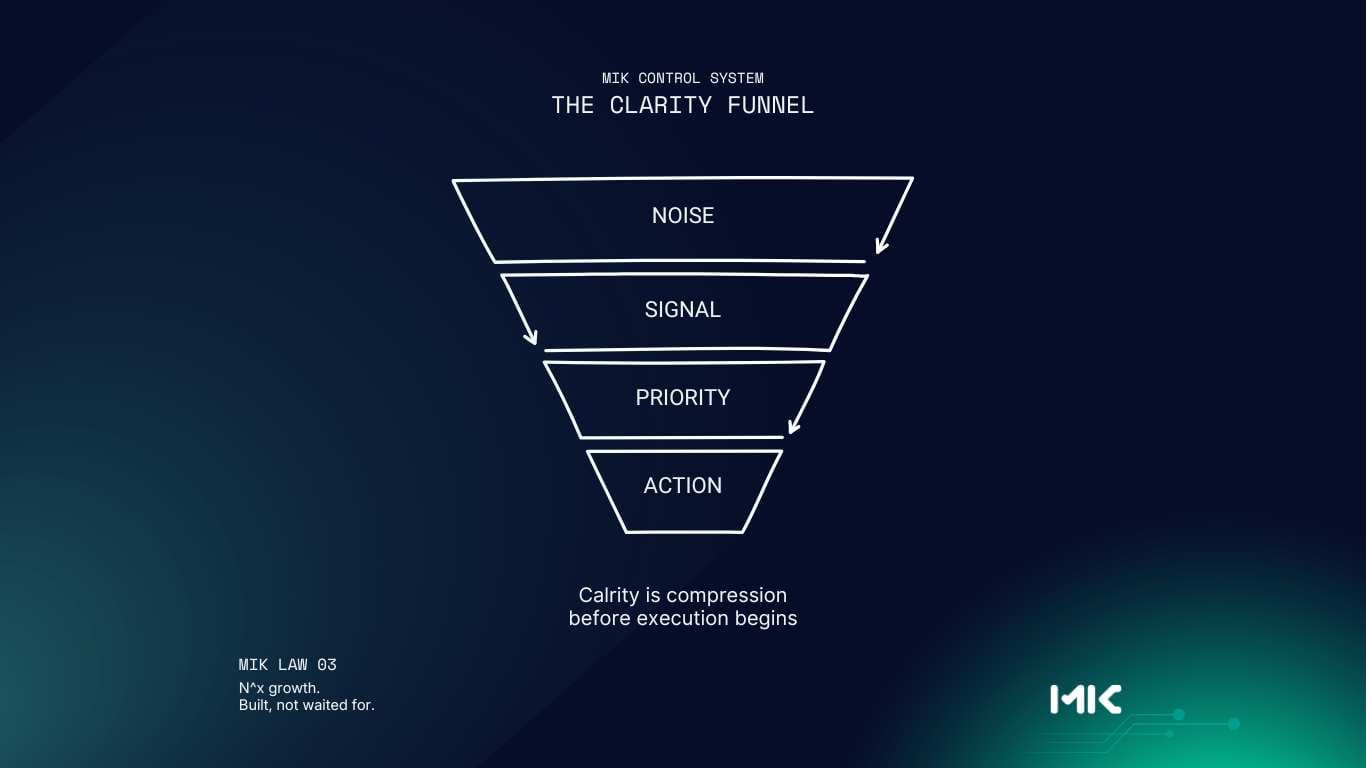
The Clarity Law can be represented through four stages:
NOISE → SIGNAL → PRIORITY → ACTION
At first glance, the model is simple.
Its implications are not.
1. NOISE
Noise is everything competing for attention. Some noise is irrelevant. More dangerously, much of it is relevant but not important enough to act on now. That distinction matters. A business can contain hundreds of legitimate opportunities, risks, requests and ideas.
The problem is not that they are wrong. The problem is that they cannot all receive equal priority simultaneously. Noise therefore includes:
information without context,
opportunities without selection,
metrics without interpretation,
activity without hierarchy,
and urgency without strategic importance.
A system that cannot filter noise eventually treats everything as significant. And when everything is significant, nothing truly is.
2. SIGNAL
Signal is the part of the noise that materially changes the decision. This requires judgment. If sales fall, the number itself is information. The signal might be that one customer segment has weakened.
Or that conversion remains strong but lead volume has declined.
Or that demand is unchanged but the sales cycle has lengthened.
Or that the issue is concentrated in one product, branch, geography or customer type.
Those interpretations can lead to completely different actions. This is why good operators do not merely ask: “What happened?”
They ask: “What does this information change?”
Signal is actionable meaning extracted from information.
3. PRIORITY
Even a valid signal does not automatically deserve immediate action. That is where priority enters. Priority asks:
What matters most?
What creates the greatest leverage?
What happens if we do nothing?
What has to happen before something else becomes possible?
What deserves scarce management attention now?
Prioritisation is where clarity becomes strategic. It acknowledges a fundamental constraint:
Resources are finite even when opportunities are not.
Capital is finite.
Time is finite.
Management attention is finite.
Team capacity is finite.
Priority allocates those scarce resources deliberately. Without priority, an organisation can become very efficient at moving in several directions at once.
4. ACTION
Clarity is incomplete until it changes behaviour. A perfectly understood problem that produces no decision has not created much operational value. Action therefore requires the final translation:
What happens?
Who owns it?
By when?
What outcome is expected?
How will we know whether it worked?
This is the point where clarity becomes execution. The complete progression is therefore:
NOISE
becomes
SIGNAL
which determines
PRIORITY
which produces
ACTION.
The organisation moves from complexity to direction.
Clarity Is Not Certainty
This distinction is essential. Clarity does not mean possessing complete information. And it does not mean being certain about the future.
In complex environments, complete certainty may never arrive. Waiting for certainty can therefore become another form of delay. Clarity asks a different set of questions:
What do we know?
What don't we know?
Which uncertainty materially affects the decision?
What assumption are we making?
What action is appropriate given the information available now?
A leader can therefore be very clear while remaining uncertain. For example:
We do not know whether demand will strengthen during the next six months. We do know our current capacity, the downside exposure and which indicators will tell us whether to accelerate investment.
That is clarity.
It does not pretend the future is known. It establishes the basis on which action will occur. This is far more useful than false certainty.
The Difference Between Simplification and Clarity
There is another trap. Complex problems should not be made artificially simple merely because simple explanations feel comfortable. Some systems are genuinely complicated.
Multiple variables interact.
Second-order effects matter.
Trade-offs exist.
Clarity therefore does not mean pretending complexity has disappeared. It means making complexity navigable.
The strongest thinkers are often able to hold considerable complexity in mind while expressing the decisive issue simply. That ability is valuable because organisations do not execute complexity directly. They execute decisions. And decisions require priorities.
Clarity Reduces the Number of Decisions
One of the most powerful consequences of clarity is that it can eliminate decisions entirely.
Consider a company where every minor commercial exception requires senior approval. At first glance, the problem appears to be decision speed. But the deeper problem may be that the organisation has never established clear principles describing:
what can be approved locally,
what requires escalation,
what thresholds matter,
and what constitutes an acceptable exception.
Once those principles become clear, hundreds of recurring decisions can disappear from senior management altogether. The system now decides. People operate inside defined boundaries. Management attention is reserved for genuine exceptions.
This is a major source of leverage.
The fastest decision is sometimes the decision the system makes unnecessary.
Clarity and Alignment
Clarity also changes organisational behaviour because people cannot align around something they interpret differently. Terms such as:
growth,
customer experience,
quality,
innovation,
efficiency,
and transformation
sound precise until several people are asked to define them. Different interpretations produce different behaviours.
If one department believes growth means revenue, another believes it means market share and a third believes it means margin, each may make internally rational decisions that collectively conflict. Strategic clarity therefore requires more than declaring objectives. It requires defining what those objectives mean operationally.
What are we trying to achieve?
Why does it matter?
How will we measure it?
What are we deliberately not prioritising?
What trade-offs are acceptable?
Clarity creates the common reference point from which alignment becomes possible.

Priority acknowledges a fundamental constraint: Resources are finite even when opportunities are not.
Clarity Is Compression Before Execution
This is where Law #3 connects directly with MIK Law #2 — The Compression Law.
The Compression Law argues that systems shorten the path by eliminating friction, waiting, rework and unnecessary sequence.
Clarity performs part of that compression before execution even starts. When direction is clear:
fewer questions travel upward,
fewer tasks begin incorrectly,
fewer people duplicate work,
fewer priorities compete simultaneously,
and fewer decisions have to be revisited.
In other words:
Clarity removes distance before movement begins.
This is why I describe clarity as compression before execution.
Speed downstream often begins with precision upstream.
Clarity and the Quality of Leadership
Leadership is sometimes associated with having more answers.
I think the more important skill is often asking better questions.
When confronted by complexity, strong leadership progressively reduces the problem.
What is actually happening?
What matters?
What is merely noise?
Where is the constraint?
What decision does this information require?
What would have to be true for our assumption to be wrong?
What is the single most important outcome now?
These questions do not necessarily make the environment simpler. They make the decision architecture clearer. This is one reason clarity can become a competitive advantage. Two leaders may possess exactly the same information.
The advantage belongs to the one who can extract the better signal from it.
The Economics of Attention
There is another dimension to clarity that is becoming increasingly important.
Attention is an economic resource.
Organisations routinely measure:
capital utilisation,
inventory utilisation,
asset utilisation,
and employee productivity.
Yet senior attention is often allocated with surprisingly little discipline. Every unnecessary meeting, unclear escalation, low-value decision and competing priority consumes part of an extremely scarce resource.
Clarity protects attention.
It determines what deserves to enter the decision system and what should remain outside it.
The result is not merely less distraction. It is more capacity for the decisions that actually change outcomes.
A Practical Clarity Audit
Take one significant priority inside any organisation and ask:
Can everyone involved describe the desired outcome in one sentence?
If not, the problem may already begin there.
Then ask:
What information genuinely matters to this decision?
What are we currently measuring that does not change action?
What is the single most important priority?
What are we explicitly choosing not to prioritise?
Who owns the outcome?
Which decisions can already be made without escalation?
What assumption are we relying on?
What would cause us to change direction?
What happens next?
If those answers require lengthy interpretation, the organisation may possess information but still lack clarity.
From Complexity to Leverage
The deeper purpose of clarity is not neatness.
It is leverage.
Clarity allows resources to concentrate.
It allows decisions to move.
It allows people to operate independently within understood boundaries.
It allows systems to distinguish exceptions from normal activity.
It allows feedback to be interpreted against an agreed objective.
And it allows an organisation to move with greater speed without necessarily adding more effort.
This matters to the broader MIK idea of Nˣ growth.
Nˣ is not intended as a literal mathematical equation.
It describes the possibility that better thinking, systems and execution can alter the relationship between input and outcome.
Clarity is one of those multipliers.
Because when a system knows what matters, less energy is wasted on what doesn't.
The Deeper Principle
Complexity is inevitable.
Confusion is not.
As businesses grow, information increases. Choices multiply. Dependencies increase. Specialisation expands.
The answer cannot therefore be to eliminate complexity entirely. The capability that matters is learning how to navigate complexity without allowing it to paralyse execution.
That begins by repeatedly moving through the same sequence:
NOISE → SIGNAL → PRIORITY → ACTION
Strip away what does not alter the decision. Identify what does. Choose what matters most. Act.
Then allow feedback to sharpen the next cycle.
That is clarity as an operating discipline.
And that brings us back to MIK Law #3:
Clarity shortens the path. Confusion lengthens it.
Because clarity does not merely help us see.
It helps us move.
MIK LAW #3 — THE CLARITY LAW
Clarity is compression before execution begins.
Nˣ growth. Built, not waited for.
Thanks for reading, Imran

IMRAN KHAN
Navigating the '1-in-a-100-year' wave of change in this era of lightning-paced progress, I stand at the forefront. With a sharp focus on digital transformation, artificial intelligence, and the dynamic domains of automotive and real estate investment, my commitment lies in forging a trail toward excellence and innovation.
Insights
Stay informed with our latest press releases, stories, announcements, and industry insights.


© 2026 MIK Consultivo


Stay in touch
© 2026 MIK Consultivo
Digital Transformation
Automotive Digitalization
Follow MIK Consultivo |