Time Compression in Business | MIK Law #2: The Compression Law
Exponential outcomes don't require linear timelines. The right system compresses the path.
Most people instinctively treat time as fixed.
If an objective traditionally takes five years, five years becomes part of the assumption. If a process normally takes ten days, ten days becomes the expected duration. If a company has always taken three weeks to make a particular decision, the organisation gradually begins to treat three weeks as though it were a property of the decision itself.
Often, it isn't.
It is a property of the system surrounding the decision.
This distinction sits at the centre of MIK Law #2 — The Compression Law.
Time cannot literally be compressed. A day remains a day.
But the amount of progress produced inside that day can change dramatically.
That is where compression begins.
The Difference Between Speed and Compression
Speed usually implies doing the same activity faster.
Compression is different.
It asks whether all the activity was necessary in the first place. Consider two organisations producing exactly the same outcome. The first requires twelve steps, five approvals, three meetings, repeated information requests and several days waiting between stages.
The second achieves the same quality of outcome through six clearly designed stages, immediate visibility, defined decision rights and automated movement of information. The second organisation may appear faster. But its people are not necessarily working faster.
Its architecture contains less wasted time.
That is compression.
The objective is therefore not:
Do everything faster.
It is:
Remove everything that unnecessarily makes the outcome slower.
That is a fundamentally different management philosophy.
The Hidden Architecture of Time
When we look at how long something takes, we tend to see one number.
Seven days.
Three months.
Five years.
But elapsed time is actually composed of several different forms of time. A useful MIK model is:
ELAPSED TIME
Value-Creating Work
+ Waiting
+ Rework
+ Decision Latency
+ Unnecessary Handoffs
+ Poor Sequencing
Only the first component necessarily creates the desired outcome. The others frequently exist because of how the system has evolved. This changes the question. Instead of asking:
“How can we work faster?”
ask:
“How much of our elapsed time is actually creating value?”
That question can expose remarkable amounts of hidden capacity.
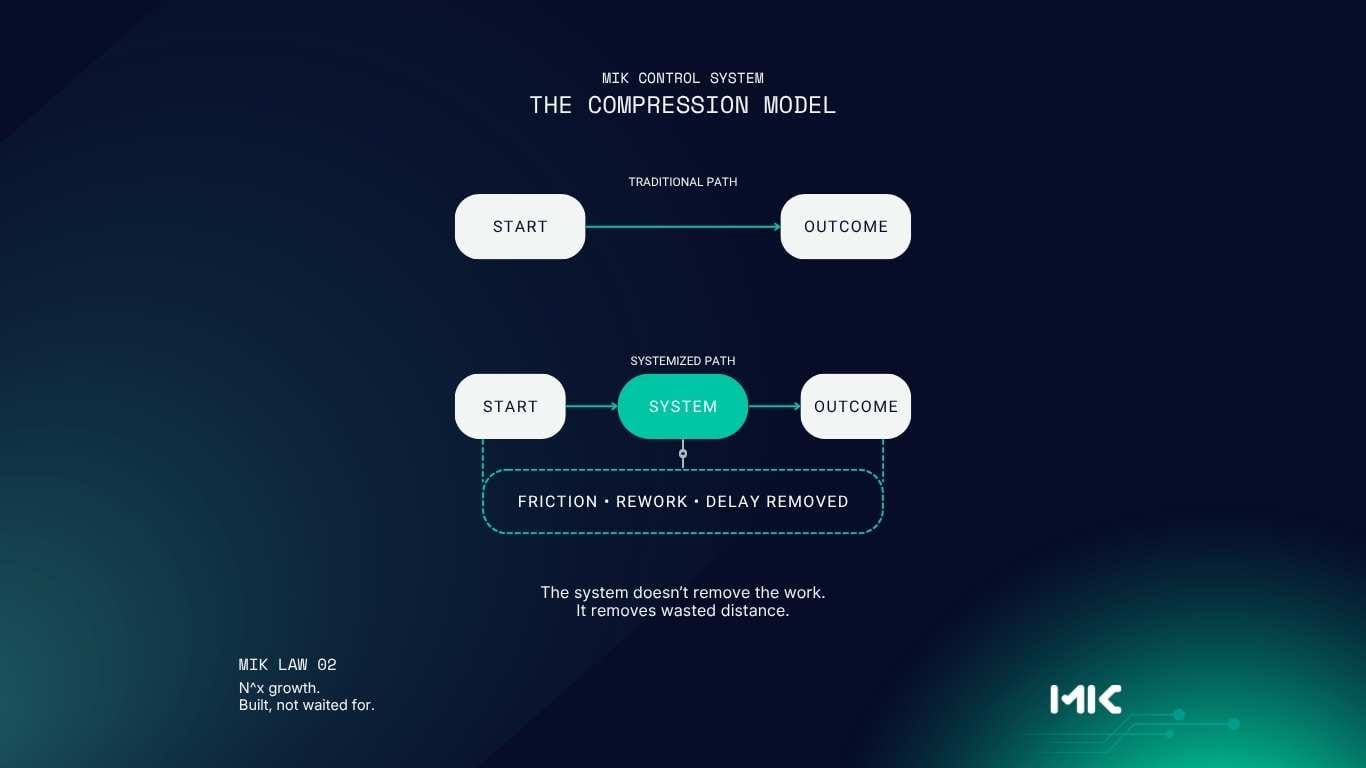
The MIK Compression Model
Visually, the principle is simple:
Traditional Path
START ─────────────────────────→ OUTCOME
Between the two sit:
WAITING • REWORK • FRICTION • HANDOFFS • DELAY
Now compare it with:
Systemised Path
START → SYSTEM → OUTCOME
The outcome has not changed. The distance required to reach it has. This is why the Compression Law is not fundamentally about speed. It is about distance.
The system doesn't remove the work. It removes wasted distance.
Five Sources of Compression
There are several ways a well-designed system can compress execution.
1. Remove Decision Latency
A surprising amount of organisational time is spent waiting for somebody to decide something. The underlying problem is often not slow people. It is unclear authority.
Who can approve?
What requires escalation?
What constitutes an exception?
What information is needed before a decision can be made?
When those rules are undefined, almost every decision travels upward.
The organisation becomes dependent on increasingly scarce senior attention. Defining decision rights can therefore create a disproportionate improvement in execution speed without changing anyone's working hours.
2. Eliminate Rework
Rework is particularly expensive because it consumes time twice. Something is performed incorrectly, incompletely or according to an unclear standard. Then somebody has to revisit it. Often the second cycle creates further questions, communication and approvals. A clear standard at the beginning can eliminate several downstream activities. This is why clarity and compression are closely related.
Ambiguity consumed early becomes time consumed later.
3. Reduce Handoffs
Every time work moves from one person, department or system to another, something can be lost.
Context.
Ownership.
Information.
Urgency.
A process containing ten handoffs doesn't merely contain ten stages. It contains nine transitions, each capable of introducing delay. Compression therefore frequently comes from redesigning the flow, not accelerating each individual activity.
4. Run the Right Activities in Parallel
Many organisations perform activities sequentially because they have always been performed sequentially.
A finishes.
Then B begins.
Then C waits for B.
But some activities may not genuinely depend on each other. Redesigning the system so appropriate activities occur simultaneously can compress elapsed time substantially without compromising quality.
This is one of the most powerful differences between task thinking and system thinking.
Task thinking asks:
What happens next?
System thinking also asks:
What could already be happening?
5. Shorten the Feedback Loop
A system improves according to how quickly it can detect the difference between expectation and reality.
If performance data becomes visible once every quarter, the organisation may spend three months repeating an avoidable mistake. If the relevant signal becomes visible daily, the learning cycle changes completely.
The faster the feedback loop:
Observe → Learn → Correct → Re-execute
the faster the system itself evolves.
Compression therefore doesn't only accelerate the current outcome. It can accelerate the rate at which the organisation becomes better at producing future outcomes.
That distinction is crucial.

Remove everything that unnecessarily makes the outcome slower.
Compression Is Not Cutting Corners
This may be the most important limitation of the principle.
Compressing time should never mean removing controls merely because they consume time. Some activities exist because they protect quality, safety, capital, compliance or judgment. Removing those steps may make a process faster while making the outcome worse.
That isn't compression.
It is degradation.
The better question is:
Which activities protect the outcome, and which merely protect the existing process?
A mature system distinguishes between the two. The objective is not the shortest process possible. It is the shortest reliable path to the required outcome.
The Constraint Is Often Architecture, Not Ambition
This has implications beyond individual processes. Organisations frequently attempt ambitious growth by increasing resources:
More people.
More capital.
More branches.
More technology.
More activity.
But if the underlying architecture remains unchanged, additional resources can simply create additional complexity. A better system can sometimes release more performance from existing resources before new resources are required.
This is one of the connections between compression and the broader MIK concept of Nˣ growth.
Nˣ is not a literal mathematical promise. It is a way of rejecting the automatic assumption that:
2× outcome must require 2× input.
Systems introduce leverage.
Automation introduces leverage.
Better sequencing introduces leverage.
Faster information introduces leverage.
Standardisation introduces leverage.
Improved decision architecture introduces leverage.
When several forms of leverage interact, the relationship between input, time and outcome can cease to feel linear.
Compression Changes Strategy
There is another implication. Time is not merely an operating metric. It can become a strategic advantage.
If two organisations identify the same opportunity but one can move from:
signal → decision → execution → feedback
significantly faster than the other, it accumulates learning sooner.
That organisation does not merely arrive first. It begins its second improvement cycle while the competitor may still be completing its first. Over multiple cycles, that difference can compound.
This is why compression and compounding belong within the same operating philosophy.
Compression creates more cycles.
Feedback improves each cycle.
Compounding preserves the gain.
A Practical Compression Audit
Take one important outcome in your organisation and map the complete journey from start to finish.
Then ask:
Where is actual value being created?
Where is the process simply waiting?
Where does information have to be requested twice?
Where does responsibility become unclear?
Which approvals genuinely protect the outcome?
Which activities could happen simultaneously?
Where does rework repeatedly occur?
How quickly does the system know when something has gone wrong?
Then look at the total elapsed time again. The difference between working time and elapsed time is often where the compression opportunity lives.
The Deeper Principle
There is a reason the phrase “compressed time” matters to me. We tend to evaluate achievement through both outcome and duration. But duration is too often treated as something that simply happens to us. Systems thinking challenges that assumption. You cannot control time itself.
But you can redesign:
the number of decisions,
the quality of information,
the sequence of actions,
the distance between feedback and correction,
the number of dependencies,
and the friction through which work must travel.
And when those variables change, the amount of progress possible within a fixed period can change with them. That is why:
Exponential outcomes don't require linear timelines.
Not because the work disappears.
Not because standards are lowered.
And certainly not because people simply work harder.
The right system compresses the path.
MIK LAW #2 — THE COMPRESSION LAW
The system doesn't remove the work.
It removes wasted distance.
Nˣ growth. Built, not waited for.
Thanks for reading, Imran

IMRAN KHAN
Navigating the '1-in-a-100-year' wave of change in this era of lightning-paced progress, I stand at the forefront. With a sharp focus on digital transformation, artificial intelligence, and the dynamic domains of automotive and real estate investment, my commitment lies in forging a trail toward excellence and innovation.
Insights
Stay informed with our latest press releases, stories, announcements, and industry insights.


© 2026 MIK Consultivo


Stay in touch
© 2026 MIK Consultivo
Digital Transformation
Automotive Digitalization
Follow MIK Consultivo |