Execution in Business: How Strategy Becomes Results | MIK Law #4
Strategy sets direction. Execution converts it into evidence.
Most organisations do not lack ideas.
They have strategies.
Plans.
Budgets.
Presentations.
Targets.
Initiatives.
Transformation programmes.
Improvement projects.
And usually, many of them are rational.
Yet there is a large gap between an organisation that knows what it wants to achieve and one that is structurally capable of making it happen.
That gap is execution.
This is the premise behind MIK Law #4 — The Execution Law:
Strategy sets direction. Execution converts it into evidence.
A strategy remains an intention until behaviour changes.
A priority remains a statement until resources move.
A target remains an aspiration until somebody owns the path toward it.
And an initiative remains a project until its effect becomes visible in the real world.
Execution is where thought becomes consequence.
Strategy Has No Value in Isolation
Strategy is essential because it answers important questions.
Where are we going?
Where will we compete?
What will we prioritise?
What capabilities do we need?
What will we deliberately not do?
But strategy alone produces nothing. A beautifully designed strategy can coexist with poor results.
The reason is simple:
Strategy and execution are different operating problems.
Strategy primarily concerns choices. Execution concerns translation. The organisation has to convert an abstract intention into:
priorities,
owners,
actions,
timelines,
resources,
standards,
measurement,
and eventually,
outcomes.
The quality of that conversion determines whether the strategy remains a document or becomes organisational behaviour.
The Execution Gap
The execution gap usually does not announce itself dramatically. It emerges through small disconnects.
A leadership team agrees on a strategic priority, but departments interpret it differently.
An initiative has several participants but no single accountable owner.
A deadline exists, but intermediate milestones do not.
People are busy, but activity is not clearly connected to the desired outcome.
Performance is reviewed, but too late to change what is happening.
Problems are discussed repeatedly without being converted into decisions.
Actions are assigned, but not systematically closed.
The strategy may still be visible everywhere.
The execution architecture is not.
This creates a dangerous illusion:
The organisation looks active while the strategy remains stationary.
Activity Is Not Execution
This distinction matters because activity is highly visible.
Emails are sent.
Meetings happen.
Tasks are completed.
Reports are prepared.
Projects advance.
People remain busy.
All of this can feel like execution. But execution should be judged by a different standard:
Did the activity materially move the intended outcome?
If not, the organisation may be producing motion rather than progress. This is one of the reasons poorly designed execution systems become exhausting. They consume large amounts of human energy without creating proportionate movement.
More effort is applied.
Management intervenes more frequently.
Meetings multiply.
Follow-up increases.
Eventually the organisation attempts to solve an architectural problem through intensity.
That rarely scales.
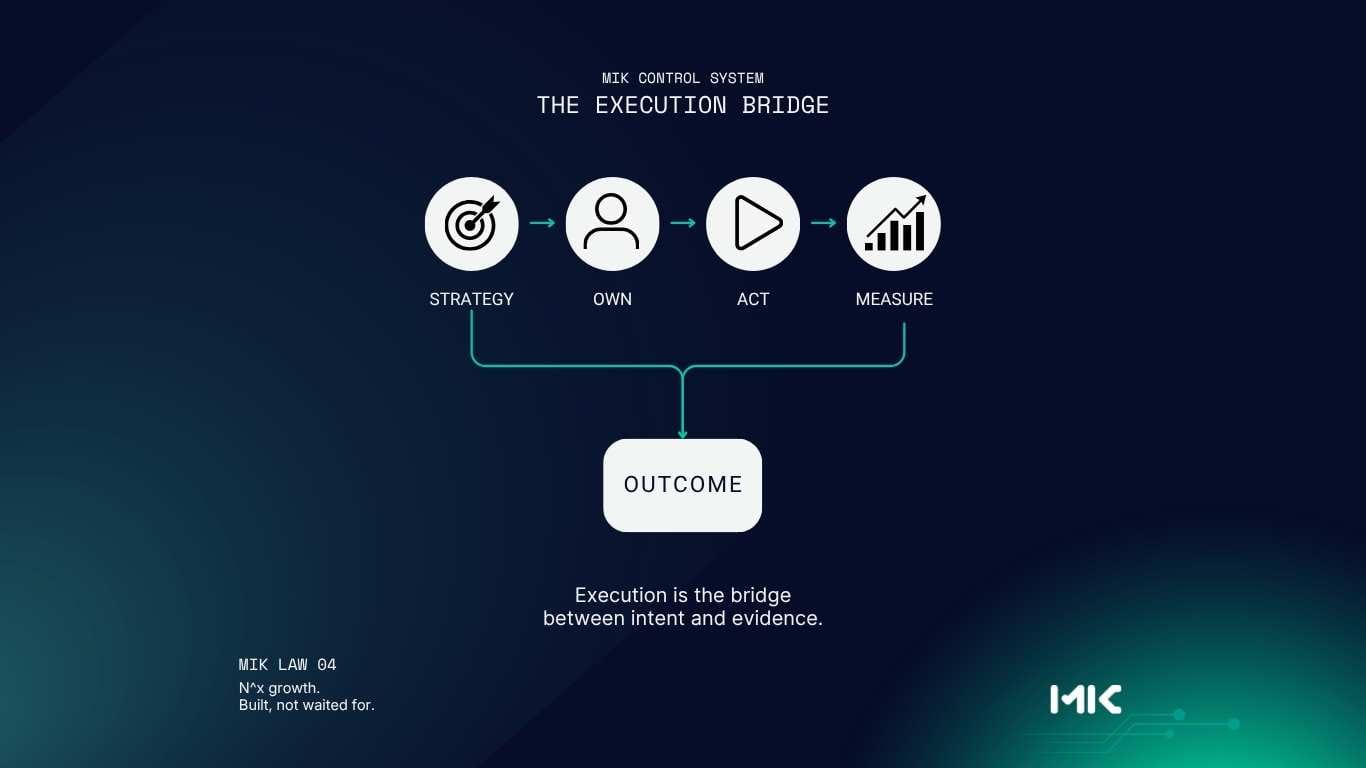
The MIK Execution Bridge
The Execution Law can be expressed through a simple architecture:
STRATEGY → PRIORITISE → OWN → ACT → MEASURE → OUTCOME
The first and final points are obvious.
The value lies in what happens between them.
1. STRATEGY — Define the Intended Direction
Execution cannot compensate indefinitely for unclear strategy. The starting point must therefore be precise enough that people can make decisions from it. A strategy should tell the organisation more than what it hopes to achieve. It should clarify:
What matters most?
Why does it matter?
What does success look like?
Which trade-offs are acceptable?
What are we not pursuing?
Without these boundaries, execution becomes fragmented because teams attempt to interpret strategy independently.
Law #3 — The Clarity Law — therefore sits naturally before Execution.
You cannot execute clearly what you have not defined clearly.
2. PRIORITISE — Convert Direction Into Few Critical Outcomes
Strategy often fails in execution because too much becomes strategically important.
Every department has initiatives.
Every initiative has justification.
Every stakeholder has priorities.
Eventually the word priority loses its meaning.
Execution requires concentration.
A useful question is:
Which few outcomes, if achieved, materially change the position of the organisation?
Those outcomes deserve disproportionate attention. This does not mean everything else stops.
It means everything else is understood relative to the few things that matter most.
Execution improves when the organisation can distinguish between:
important work
and
work that defines the outcome.
The Cost of Too Many Priorities
Every additional priority creates coordination cost. More priorities require:
more meetings,
more management attention,
more resource allocation,
more communication,
more dependencies,
and more trade-offs.
The organisation's available energy becomes increasingly fragmented. This is why ten priorities do not usually create ten times the progress of one. They can create ten competing claims on the same finite capacity. Execution therefore begins partly through subtraction.
A strategy becomes executable when it has been reduced sufficiently for the organisation to concentrate.
3. OWN — Give the Outcome a Name and a Person
One of the most common execution failures is shared responsibility without clear accountability.
Several people participate. Everyone understands the objective. Nobody is clearly responsible for ensuring that the outcome actually occurs. This produces a familiar pattern. Problems sit between departments. Decisions remain unresolved. Actions become dependent on collective follow-up.
Meetings become the mechanism through which ownership is temporarily reconstructed.
Strong execution requires a clearer principle:
Collaboration can be shared. Accountability cannot.
Every meaningful outcome should have an identifiable owner.
That owner does not necessarily perform every task.
The role is to ensure that:
the work moves,
dependencies are resolved,
issues become visible,
decisions are obtained,
and the outcome remains connected to the original objective.
Ownership turns a strategic intention into an operating responsibility.
Ownership Is Not Blame
This distinction is important.
Poorly designed accountability cultures make ownership threatening. If ownership is primarily associated with blame when something fails, people naturally become defensive. Strong ownership means something different. It creates clarity about:
who watches the outcome,
who raises the exception,
who convenes the response,
and who knows whether the work is moving as expected.
Ownership should reduce ambiguity, not create fear.
A mature execution system asks:
Who owns making the result happen?
rather than:
Who can we blame if it does not?
4. ACT — Translate the Outcome Into Movement
At some point, thinking must become action. But the quality of action matters.
Large objectives often fail because they remain too large to execute directly.
“Improve customer experience.”
“Grow market share.”
“Digitally transform the organisation.”
“Improve operational efficiency.”
These may be legitimate strategic ambitions. But none describes what somebody should do at 9:00 tomorrow morning. Execution therefore requires decomposition. A strategic outcome must become:
initiatives,
milestones,
decisions,
tasks,
dependencies,
and deadlines.
The objective remains connected to strategy, but the work becomes concrete enough to move.
This is where execution discipline begins.
Cadence Matters More Than Occasional Intensity
Many organisations execute in bursts. A project becomes urgent. Teams mobilise. Senior leadership becomes heavily involved. Activity accelerates. Then attention moves elsewhere. Momentum decays.
This pattern creates dependence on urgency.
A stronger system uses cadence.
Weekly.
Daily.
Monthly.
Whatever rhythm fits the nature of the work.
The important point is that progress is reviewed frequently enough for deviations to be corrected while they are still small.
Execution should not rely on remembering to check.
The system should create the check.
This transforms progress from an event into a rhythm.
5. MEASURE — Convert Activity Into Evidence
Measurement is the point where execution meets reality. Without it, organisations can become attached to narratives about progress.
“We are working on it.”
“The team is making good progress.”
“The project is nearly complete.”
“We have had several meetings.”
None of those statements necessarily demonstrates movement toward the outcome. A useful execution metric should answer one of three questions:
Did it happen?
Is performance moving?
Are we on course?
This may involve:
completion measures,
leading indicators,
quality measures,
financial outcomes,
cycle times,
conversion rates,
utilisation,
customer measures,
or operational performance.
The metric depends on the objective.
The principle does not.
Execution requires evidence.
Measure Outcomes, Not Just Activity
There is a subtle but important difference between measuring work and measuring effect.
A sales team may make more calls.
A workshop may process more jobs.
A marketing team may publish more content.
A management team may hold more reviews.
Those are activity metrics. They can be useful, particularly as leading indicators. But activity becomes valuable only when it creates an outcome. The better execution question is therefore:
What changed because the activity happened?
Calls should ultimately connect to conversion. Workshop throughput should connect to turnaround time, uptime or customer outcomes. Content should connect to reach, authority, engagement or demand.
Meetings should connect to decisions and completed actions.
Measurement should maintain the line between effort and result.
Feedback Makes Execution Adaptive
Execution is sometimes described as though strategy is decided first and then mechanically implemented. Reality is rarely that clean. Markets change. Customers respond differently than expected. Technology evolves. Costs move. Competitors react. Internal assumptions prove wrong.
Execution therefore generates information that strategy did not possess at the beginning. This makes feedback essential. The execution cycle becomes:
ACT → MEASURE → LEARN → ADJUST → ACT AGAIN
This is why execution and learning should not be separated.
A strong organisation does not simply execute a plan.
It allows execution to continuously improve the plan.
The purpose is not blind adherence. It is disciplined progress toward the intended outcome.
Execution Is Where Assumptions Meet Reality
Every strategy contains assumptions.
Demand will exist.
Customers will respond.
A process will perform.
A price will be accepted.
A capability can be built.
A market will move in a particular direction.
Before execution, these assumptions exist primarily inside models and conversations. Execution exposes them to reality. This makes action informational.
Execution does not only produce outcomes. It produces knowledge.
That insight is particularly important in uncertain environments. When certainty is unavailable, the organisation can sometimes design smaller, faster execution cycles that generate real evidence. Instead of debating indefinitely:
test,
observe,
learn,
adjust.
This is where execution begins to interact with the broader MIK ideas of compression, decision velocity and compounding.
The Four Execution Failures
Most execution problems can be traced back to four broad failures.
1. Translation Failure
People understand the strategy conceptually but cannot translate it into concrete actions.
The cure is decomposition.
2. Ownership Failure
The work exists, but accountability is diffuse.
The cure is explicit ownership.
3. Visibility Failure
Work is happening, but management cannot see progress, constraint or deviation early enough.
The cure is measurement and operating cadence.
4. Learning Failure
Performance is measured, but feedback does not alter the system.
The cure is structured correction.
These four failures explain why adding pressure alone rarely repairs execution. Pressure may temporarily increase effort. It does not necessarily repair the architecture through which effort moves.
Execution and the System Law
This is where Law #4 connects back to MIK Law #1 — The System Law.
Without a system, execution often depends on individual memory, personal follow-up and heroic intervention. A strong manager can keep many moving parts together. But as complexity increases, this model reaches a natural limit. A repeatable execution system embeds:
priorities,
ownership,
cadence,
visibility,
escalation,
and feedback
into the way the organisation operates. The objective is not to remove leadership. It is to stop wasting leadership capacity on work the system should already control.
That creates leverage.

Strategy sets direction. Execution converts it into evidence.
Execution and Compression
Law #2 argued that time can be effectively compressed by removing friction, waiting, rework and unnecessary sequence. Execution architecture is one of the main mechanisms through which that compression occurs.
When ownership is clear, work waits less.
When priorities are clear, resources fragment less.
When decisions are visible, escalation becomes faster.
When measurement is timely, problems are corrected earlier.
When feedback alters the next cycle, repeated mistakes decline.
The execution system therefore does more than increase completion.
It changes the amount of useful progress created per unit of time.
Execution Without Micromanagement
There is a common misconception that tighter execution requires tighter supervision.
Often the opposite is true.
Micromanagement becomes necessary when the system lacks clarity.
If priorities are ambiguous, managers intervene.
If ownership is unclear, managers chase.
If visibility is poor, managers ask for updates.
If standards are undefined, managers inspect personally.
If exceptions are invisible, managers remain constantly involved.
Better execution architecture can actually create greater autonomy. When people know:
the outcome,
the boundaries,
the standard,
the authority they possess,
and how performance will be measured,
they require less continuous intervention.
Control through architecture is more scalable than control through presence.
This principle will become particularly important later in MIK Law #13 — The Control Law.
The Execution Question
A useful test for any strategy is remarkably simple:
What happens differently on Monday morning because we agreed this?
If the answer is unclear, the strategy probably has not yet crossed into execution.
A strategy should eventually change:
what somebody does,
what somebody stops doing,
where resources move,
how decisions are made,
what is measured,
and what gets reviewed.
If none of these changes, the strategy may exist intellectually but not operationally.
A Practical Execution Audit
Take one strategic priority and ask:
Can we describe the desired outcome precisely?
Then ask:
What are the three most important actions required to move it?
Who owns the outcome—not merely the tasks?
What is the next measurable milestone?
What dependencies could stop progress?
What decisions are currently waiting?
How frequently will progress become visible?
What metric demonstrates movement rather than activity?
What happens when performance deviates from expectation?
What have we learned from execution so far?
Has that learning changed the next action?
If those questions cannot be answered quickly, the execution architecture probably needs strengthening.
From Intent to Evidence
There is a deeper idea behind the Execution Law.
Ideas exist in a world of possibility. Execution moves them into a world of evidence. Before execution:
the concept may work.
the customer may buy.
the process may improve.
the investment may produce the expected outcome.
the strategy may succeed.
After execution, reality begins answering those questions. That is why operators place such value on execution. Not because thinking is unimportant. But because thought reaches its highest value when it becomes testable.
A strategy that enters execution can learn.
A strategy that remains theoretical cannot.
Execution and Nˣ
The broader MIK concept of Nˣ growth is based on the idea that outcomes do not always need to scale linearly with inputs.
But leverage remains theoretical unless it reaches execution.
A better process has no value if unused.
Automation has no value if poorly adopted.
A strategic insight has no value if no decision follows.
A system has no value if people operate around it.
Execution is therefore where potential leverage becomes actual leverage.
It converts:
knowledge into behaviour,
systems into performance,
strategy into action,
and eventually,
action into outcomes.
This is why execution sits at the centre of any serious operating philosophy.
The Deeper Principle
Great execution is not simply about doing more.
It is about maintaining an unbroken line between:
INTENT → OWNERSHIP → ACTION → EVIDENCE → LEARNING
If any link breaks, execution weakens.
Without intent, activity loses direction.
Without ownership, action loses accountability.
Without action, strategy remains theoretical.
Without evidence, progress becomes subjective.
Without learning, the organisation repeats yesterday's system.
Strong execution connects all five. And as those connections become repeatable, execution itself becomes a capability rather than an occasional achievement. That is the real objective. Not one successfully completed initiative. But an organisation increasingly capable of converting intention into outcomes again and again.
That brings us back to MIK Law #4:
Strategy sets direction. Execution converts it into evidence.
A strategy tells us what should happen.
Execution proves what can.
MIK LAW #4 — THE EXECUTION LAW
Strategy creates potential.
Execution creates evidence.
Nˣ growth. Built, not waited for.
Thanks for reading, Imran

IMRAN KHAN
Navigating the '1-in-a-100-year' wave of change in this era of lightning-paced progress, I stand at the forefront. With a sharp focus on digital transformation, artificial intelligence, and the dynamic domains of automotive and real estate investment, my commitment lies in forging a trail toward excellence and innovation.
Insights
Stay informed with our latest press releases, stories, announcements, and industry insights.


© 2026 MIK Consultivo


Stay in touch
© 2026 MIK Consultivo
Digital Transformation
Automotive Digitalization
Follow MIK Consultivo |