MIK Law #1 — The System Law
Effort Creates Movement. Systems Create Repeatable Outcomes.
There is a point in almost every growing organisation where effort stops being the answer.
The instinct is usually to push harder.
More meetings. More follow-up. More people. More hours. More pressure.
For a while, it works.
Then complexity catches up.
Performance becomes dependent on particular people. Decisions accumulate at the top.
The same mistakes reappear. Successful outcomes are difficult to reproduce. Growth adds activity, but not necessarily capability.
The problem is no longer effort.
The problem is the system.
That is the premise behind MIK Law #1 — The System Law:

Effort creates movement. Systems make performance repeatable.
Because once an outcome becomes repeatable, something important changes.
It can be measured.
What can be measured can be understood.
What can be understood can be improved.
And what can be improved and repeated can eventually be scaled.
That is where ordinary growth begins to become something more powerful.
From Heroics to Architecture
Many businesses contain exceptional people producing exceptional results.
That is valuable—but it can also hide weak architecture.
If the organisation requires the same individual to remember every detail, solve every exception, chase every action and intervene whenever something goes wrong, the business may be performing—but the system isn't.
Heroics create dependence.
Systems create capability.
The objective is therefore not to remove human judgment. Quite the opposite.
A good system removes unnecessary cognitive load so that human judgment can be concentrated where it creates the greatest value.
Routine becomes structured.
Exceptions become visible.
Ownership becomes clear.
Feedback becomes faster.
People spend less time reconstructing how work should happen and more time improving what happens next.
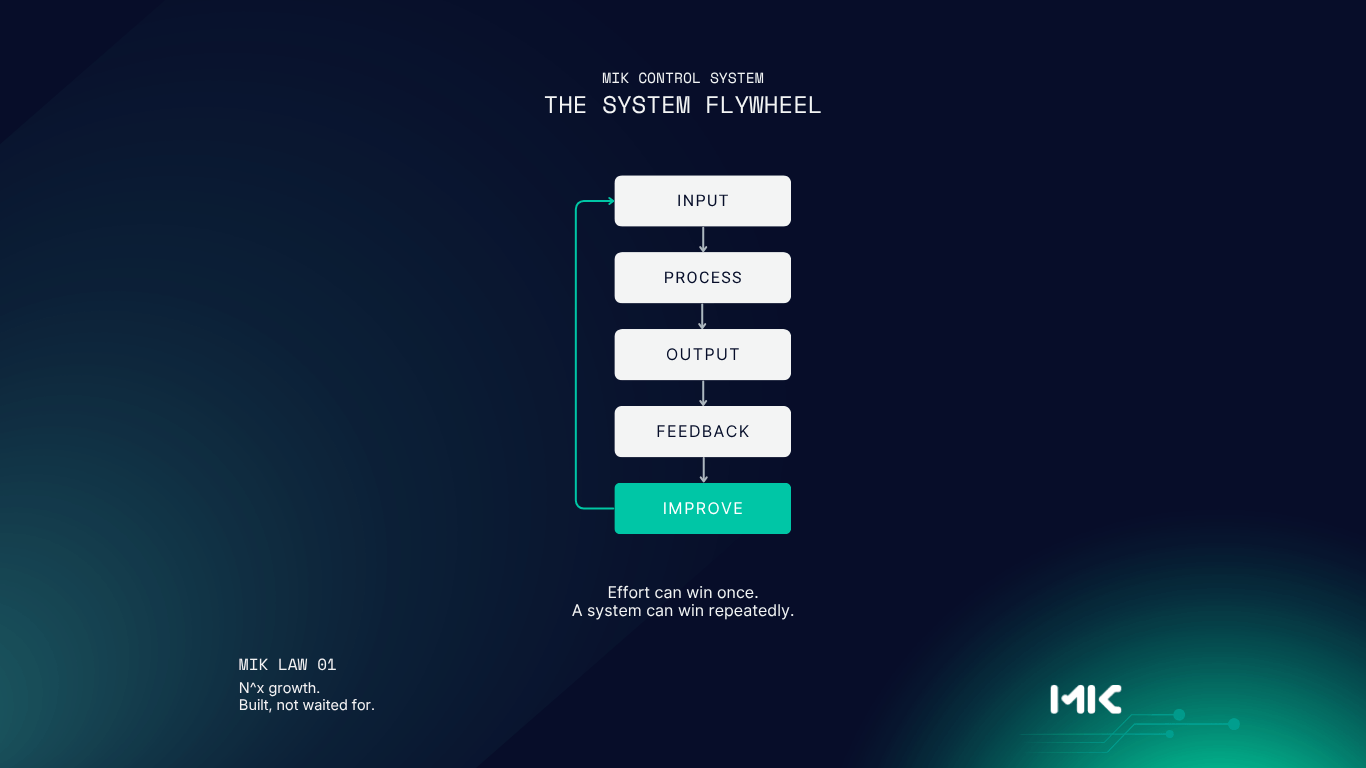
The MIK System Flywheel
At its simplest, a functioning system contains five elements:
INPUT → PROCESS → OUTPUT → FEEDBACK → IMPROVE → REPEAT
INPUT
Every system begins with something entering it: information, capital, a customer requirement, an opportunity, a vehicle, a task, a lead, a decision. Poor inputs create noise downstream. The first discipline is therefore understanding precisely what is entering the system and what good looks like.
PROCESS
The process is the repeatable method by which the input is converted. This is where complexity either multiplies or disappears. A strong process answers basic questions without requiring constant intervention:
Who owns it?
What happens next?
By when?
According to what standard?
What happens when reality differs from the standard?
OUTPUT
A system must produce something observable. Not activity.
Outcome.
A completed job. A decision. A delivered product. A converted opportunity. Reduced turnaround time. Higher utilisation. Lower cost. Better customer experience. If the output cannot be defined, the system cannot meaningfully be improved.
FEEDBACK
This is where many processes stop and real systems begin. A process executes.
A system learns.
Feedback compares what happened with what should have happened.
Where did the delay occur?
Where was value lost?
What assumption proved wrong?
What worked particularly well?
Feedback converts experience into information.
IMPROVE
Information without correction creates reporting, not improvement. The final step is therefore to change the system. Remove friction. Change the sequence. Improve the standard. Automate the repeatable.
Clarify ownership.Eliminate an unnecessary decision. Then execute again.
The cycle becomes:
Perform → Observe → Learn → Improve → Repeat.
And every successful iteration creates a stronger starting point for the next.
Why Systems Change the Growth Equation
Linear growth usually asks:
How do we do more?
System thinking asks a different question:
How do we make each unit of effort produce more?
That distinction matters.
If doubling output always requires doubling people, doubling management attention and doubling working hours, the organisation may be growing—but it is not truly scaling.
A system creates leverage. Knowledge becomes embedded rather than remembered. Processes become transferable rather than personal. Improvement becomes cumulative rather than temporary. Execution becomes increasingly independent of heroic intervention.
This is where the MIK idea of Nˣ growth enters.
Nˣ is not intended as a literal mathematical formula. It represents a different mental model:
Stop assuming that input and output must increase at the same rate.
If better systems improve decision speed, reduce friction, preserve learning and make successful execution repeatable, then the relationship between effort and outcome can change dramatically.
The objective becomes less:
MORE INPUT → MORE OUTPUT
and increasingly:
BETTER SYSTEM → GREATER YIELD FROM THE SAME INPUT
That is leverage.
Systems Do Not Mean Bureaucracy
There is an important distinction. A badly designed system adds steps. A well-designed system removes them. The purpose of systemisation is not to create paperwork, committees or approval chains.
It is to make execution:
clearer, faster, more visible and more repeatable.
If a system increases friction without improving control or output, it needs redesign. Good systems should make work feel simpler.
A Useful System Test
Take any important process and ask five questions:
Can another capable person reproduce the outcome?
Is ownership obvious at every stage?
Can I see where performance deviates from the standard?
Does feedback alter what happens next?
Does the system improve as experience accumulates?
If the answer to most of those questions is no, you probably do not yet have a system. You have a sequence of activities held together by people. There is a difference.
The Larger Principle
The most interesting thing about systems is that the principle travels. The environment may change. The variables may change. The desired outcome may change. But the underlying architecture remains remarkably consistent:
Define → Execute → Measure → Learn → Improve.
That is why systems thinking can travel between industries, technologies and asset classes. The expertise is not merely knowing one environment. It is learning how to identify the underlying system quickly enough to improve it.
And that brings us back to MIK Law #1:
Effort creates movement. Systems make performance repeatable.
Effort matters.
But when effort becomes architecture, something far more powerful becomes possible.
Repeatability becomes improvement.
Improvement becomes leverage.
Leverage creates the conditions for Nˣ.
MIK LAW #1
Nˣ growth. Built, not waited for.
Thanks for reading, Imran

IMRAN KHAN
Navigating the '1-in-a-100-year' wave of change in this era of lightning-paced progress, I stand at the forefront. With a sharp focus on digital transformation, artificial intelligence, and the dynamic domains of automotive and real estate investment, my commitment lies in forging a trail toward excellence and innovation.
LINKEDIN TWITTER FACEBOOK INSTAGRAM
Insights
Stay informed with our latest press releases, stories, announcements, and industry insights.


© 2026 MIK Consultivo


Stay in touch
© 2026 MIK Consultivo
Digital Transformation
Automotive Digitalization
Follow MIK Consultivo |