Business Multipliers: How Systems Create Nonlinear Growth | MIK Law #5
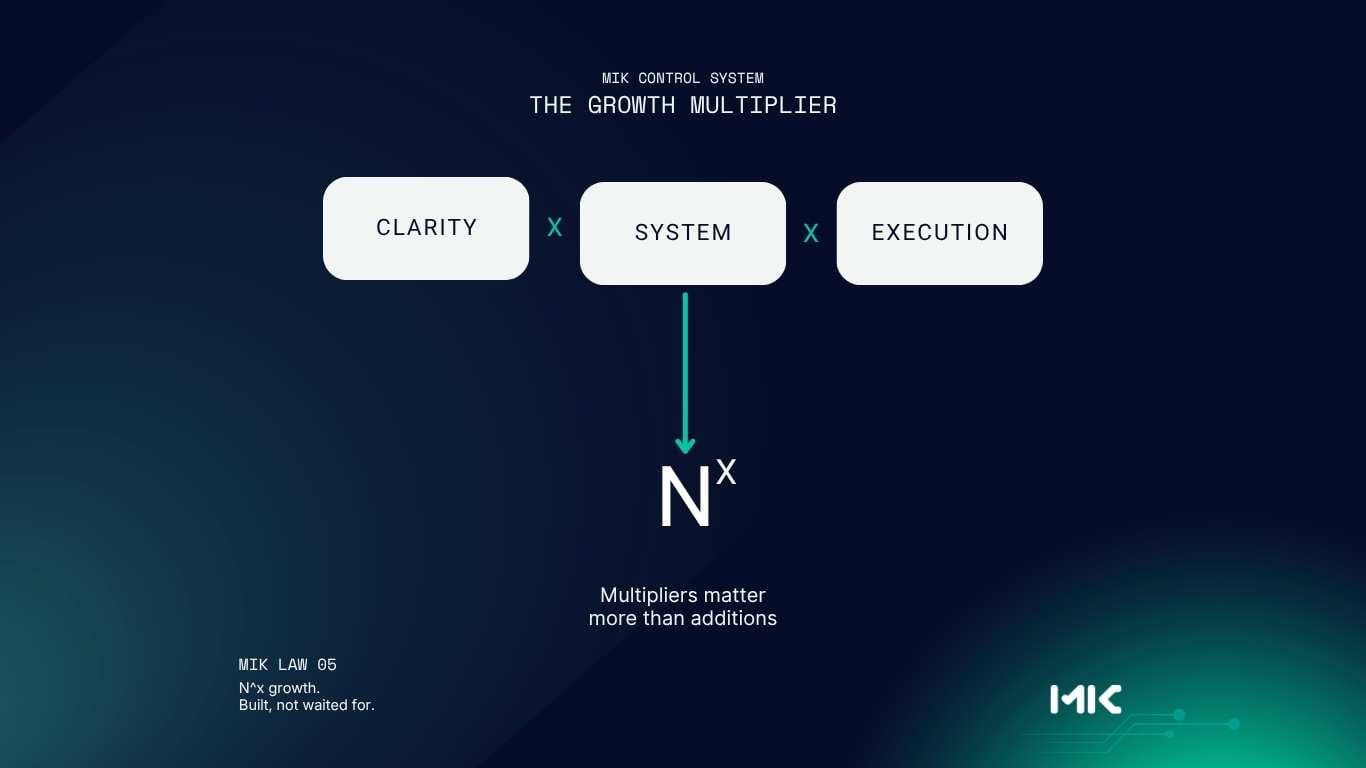
Clarity × System × Execution → Nˣ
Most growth plans begin with addition.
More people. More capital. More inventory. More branches. More customers. More technology. More hours. More activity. Sometimes that is exactly what the business needs.
But addition has a natural limitation: every increase in output remains dependent on another increase in input.
If doubling revenue always requires doubling people, doubling management attention, doubling infrastructure and doubling operating complexity, the organisation may be becoming larger without becoming fundamentally more capable.
That is the distinction behind MIK Law #5 — The Multiplier Law.
Clarity × System × Execution → Nˣ
The notation is conceptual rather than a literal mathematical equation.
Its purpose is to express a different way of thinking about growth.
Additive thinking asks:
What else can we put into the system?
Multiplier thinking asks:
How can the system make every existing input more productive?
That is where leverage begins.
Addition Improves Capacity. Multiplication Changes Capability.
Imagine a business that needs to produce 20% more output.
The most obvious response may be to increase resources by roughly the same amount.
More employees.
More equipment.
More working hours.
More management.
That is additive growth.
The organisation receives more input and therefore produces more output.
There is nothing inherently wrong with that.
But now imagine the same organisation improves its process so that:
information arrives earlier,
decisions take half the time,
rework falls,
responsibilities become clearer,
automation handles repeatable tasks,
and performance feedback becomes immediate.
The organisation may now increase output without an equivalent increase in resources.
Something different has happened. The system has become more productive.
That is a multiplier.
The difference is subtle but strategically important:
Capacity increases how much an organisation can do.
Capability improves what the organisation can produce from what it already has.
The most powerful growth strategies usually contain both. But capability should often be examined before capacity is simply added.
Why Multiplication Is Different
Addition behaves predictably.
Add one salesperson and, all else being equal, some additional capacity becomes available.
Add another vehicle, production line or branch and physical capacity increases.
Multipliers behave differently because they affect several activities simultaneously.
For example, improving the quality of information may improve:
sales decisions,
inventory decisions,
pricing decisions,
resource allocation,
customer response,
and management visibility
at the same time.
A stronger system can therefore improve multiple outputs from a single intervention.
That is leverage.
This is the central idea of the Multiplier Law.
A multiplier changes not merely the amount of resource available.
It changes the yield of the resource already present.

Additive thinking asks how much more we can put in. Multiplier thinking asks how much more every existing input can produce.
The MIK Growth Multiplier
The Multiplier Law uses three foundational variables:
CLARITY × SYSTEM × EXECUTION → Nˣ
Each plays a different role.
Clarity determines where energy goes.
Systems determine how efficiently energy moves.
Execution determines whether that energy becomes an outcome.
When all three strengthen together, they can create an effect greater than improving any single factor in isolation.
1. CLARITY — Direct the Energy
Law #3 established that clarity converts:
NOISE → SIGNAL → PRIORITY → ACTION
Without clarity, resources fragment.
People work on legitimate but competing priorities.
Management attention is divided.
Decisions are repeatedly revisited.
The organisation may possess significant energy while lacking concentration.
Clarity is therefore a multiplier because it increases the percentage of organisational effort directed toward what materially matters.
Consider two teams with identical capability and identical working hours.
One receives a broad instruction containing several competing priorities.
The other knows precisely:
the outcome,
the priority,
the decision criteria,
and what is deliberately outside scope.
The second team may produce far more useful output without receiving any additional resources.
Nothing has been added.
Direction has improved the yield of the existing resource.
That is multiplication.
2. SYSTEM — Increase the Yield
The System Law established that repeatability creates the foundation for measurement, improvement and scale.
Systems become multipliers because they allow learning to remain inside the organisation.
Without a system, every successful outcome risks becoming a one-off event.
Somebody remembers what worked. Another person develops their own method. A third team reinvents the process. Knowledge exists, but it does not necessarily accumulate. A system changes this.
The organisation discovers a better method.
The method becomes standard.
The standard is repeated.
Feedback improves the standard. The improvement becomes available to everyone using the system.
One improvement therefore influences many future executions. This is a fundamental multiplier effect.
The value of an improvement is no longer limited to the person who discovered it.
It becomes embedded in the architecture.
3. EXECUTION — Convert Potential Into Reality
The first two variables can still exist theoretically.
An organisation can possess clarity and design excellent systems but produce little if execution remains weak. Execution is the conversion factor. It moves:
strategy into behaviour,
process into activity,
measurement into correction,
and intention into evidence.
This is why the variables are expressed multiplicatively rather than as a simple list. If one variable is extremely weak, the total effect is constrained.
Excellent execution directed toward the wrong priority creates waste.
Excellent strategy inside a poor system creates friction.
Excellent systems without disciplined execution create unused capability.
The strength of the whole is influenced by the weakness of the multiplier.
That principle matters.
Because organisations often respond to disappointing performance by investing further in the factor that is already strongest.
A strategy-heavy organisation creates another strategy.
A technology-heavy organisation purchases another platform.
A sales-driven organisation adds more salespeople.
A process-heavy organisation creates more procedures.
But the highest-leverage intervention may sit somewhere else entirely.
Multipliers Expose Constraints
This leads to one of the most useful applications of the Multiplier Law.
If growth depends on interacting variables, improvement should not always focus on the largest visible problem. It should focus on the variable that most constrains the overall system.
Imagine:
Clarity = strong.
Systems = strong.
Execution = weak.
Adding even more strategic analysis will have limited effect because strategy is not the binding constraint.
The system needs execution. Now reverse it.
Execution = strong.
Systems = weak.
People work extremely hard, but each result requires heavy intervention and repeated problem-solving.
The constraint is architectural.
More pressure may increase activity while actually making the organisation more dependent on heroics.
Multiplier thinking therefore changes management's question.
Instead of:
“Where can we improve?”
ask:
“Which variable currently limits the performance of the whole?”
That is a much more powerful diagnostic.
The Zero-Factor Problem
Multiplication contains another useful idea.
In a mathematical multiplication, one factor approaching zero can dramatically reduce the total result.
The MIK equation is not literal mathematics, but the analogy is valuable. Consider a powerful business proposition with:
excellent strategy,
strong market demand,
significant capital,
and superior technology.
If nobody executes consistently, the commercial value can still approach zero.
Or consider exceptional execution applied to a fundamentally confused objective. The organisation may move quickly in the wrong direction. This is the zero-factor problem.
It explains why excellence in one area does not automatically compensate for structural weakness elsewhere.
Many organisations contain individual areas of brilliance.
The objective is to ensure that brilliance is connected through an operating system capable of multiplying it.
Multipliers Can Be Small
The word multiplier can sound dramatic.
It does not need to be.
A five-minute reduction in one recurring process may appear insignificant.
But if that process occurs:
100 times per day,
across several branches,
throughout the year,
the total effect becomes very different.
Likewise:
a slightly better conversion rate,
a modest reduction in rework,
a small improvement in asset utilisation,
a faster decision cycle,
or a minor improvement in inventory accuracy
can become significant when repeated at scale.
This is where multiplier thinking intersects with Kaizen.
The improvement may be small.
The multiplication comes from frequency, repeatability and scale.
Technology Is a Multiplier — But Only Sometimes
Technology is frequently described as a multiplier.
It can be.
Software can allow one person to perform work that previously required several.
Automation can eliminate repetitive decisions.
AI can accelerate analysis.
Shared data can remove information delays.
Digital workflows can compress handoffs.
But technology is not automatically leverage. If it automates a poor process, the organisation may simply perform the wrong activity faster. If adoption is weak, capability exists but is unused. If data quality is poor, the technology can amplify bad information.
If the operating model remains unclear, another platform can create another layer of complexity. The real multiplier is therefore not technology alone. It is:
Technology × Process × Adoption × Execution
Again, the interacting system matters more than the isolated component.
People Are Multipliers Too
Multiplier thinking should never be interpreted as replacing people with systems.
Strong people can themselves be extraordinary multipliers.
A great manager improves the performance of an entire team.
A strong technician teaches a method that improves many future jobs.
An excellent salesperson shares an approach that raises conversion across the department.
A leader creates clarity that removes hundreds of unnecessary decisions.
The multiplier effect comes when individual capability becomes transferable capability.
This is why teaching, standards, coaching, documentation and system design matter.
If expertise remains trapped inside one person, its value is limited by that individual's time.
If expertise becomes embedded in the system, its value can spread.
The question becomes:
How do we turn individual excellence into organisational capability?
That is multiplier thinking.
The Difference Between Growth and Scale
Growth and scale are often used interchangeably.
They should not be.
Growth means producing more.
Scale means producing more without requiring input to increase at the same rate.
The Multiplier Law therefore sits directly underneath scalable business models.
An organisation scales when:
one improvement affects many transactions,
one system serves many users,
one insight improves many decisions,
one platform connects many processes,
one standard improves many locations,
or one capability becomes reproducible across the organisation.
Scale is multiplication made operational.
This principle will be developed further in MIK Law #15 — The Scale Law.
The Management Attention Multiplier
One of the least discussed multipliers is management attention.
Senior attention is limited.
If leaders spend most of their time:
chasing actions,
resolving recurring problems,
approving routine exceptions,
searching for information,
and manually coordinating activity,
very little attention remains for:
strategy,
customers,
innovation,
capital allocation,
people development,
and future opportunities.
A well-designed operating system can therefore create leverage by releasing attention.
This is strategically important.
The value of a system should not only be measured by the labour it saves.
It should also be measured by the quality of attention it frees.
An hour returned to low-value activity is merely an hour saved.
An hour returned to a high-leverage decision-maker may create disproportionate value.
Multipliers Across Different Environments
One of the reasons multiplier thinking matters is that the underlying principle travels.
In an automotive operation, a multiplier might be:
better workshop throughput,
greater parts availability,
higher vehicle uptime,
improved lead conversion,
or faster customer response.
In technology, it might be:
automation,
integrated data,
workflow orchestration,
or predictive insight.
In investment, it might be:
capital structure,
asset utilisation,
financing,
or reinvestment.
The variables differ.
The underlying question remains the same:
What intervention improves the yield of the entire system rather than only one isolated activity?
That is why first-principles operating ideas can move between industries.
Different environment.
Same architecture.
Multipliers Can Also Work Against You
Not every multiplier is positive.
Poor systems multiply errors.
Unclear communication multiplies confusion.
Bad incentives multiply unwanted behaviour.
Weak data multiplied through automation can create faster bad decisions.
Poor culture replicated across locations becomes a scaled problem.
This is why scale before system quality can be dangerous.
Anything repeatable can compound — including dysfunction.
Before asking how to amplify something, determine whether it deserves amplification.
This is an important counterweight to simplistic ideas about exponential growth.
Growth without quality can magnify weakness.
Multiplier thinking therefore requires discipline.
The MIK Multiplier Audit
Take one important outcome and ask:
What currently drives this result?
Then identify the variables.
For example:
Demand × Conversion × Capacity × Availability × Execution
or:
Opportunity × Decision Speed × Process × Follow-Through
The precise equation matters less than the thinking. Then ask:
Which factor is strongest?
Which factor is weakest?
Which improvement would affect several downstream outcomes at once?
What expertise currently exists in individuals but not in the system?
What activity repeats often enough that a small improvement would compound?
Where is management attention being consumed unnecessarily?
What technology could multiply a good process?
What technology is currently multiplying a poor one?
What can be standardised once and used many times?
What should not be scaled until it is improved?
The exercise forces the organisation to look beyond additional resources.
It asks where leverage actually lives.
From Addition to Leverage
The first stage of many businesses naturally relies on addition.
More customers require more work.
More work requires more people.
More people require more supervision.
This is normal.
But as an organisation matures, the strategic question should evolve.
Instead of continuously asking:
What else must we add?
begin asking:
What can we multiply?
Can information multiply decision quality?
Can systems multiply expertise?
Can automation multiply capacity?
Can standards multiply consistency?
Can better processes multiply asset utilisation?
Can leadership clarity multiply team performance?
Can feedback multiply learning?
The shift is profound.
Because growth stops being solely a question of resources.
It becomes a question of architecture.
Multipliers and the Previous Four Laws
Law #5 is also where the first four MIK Laws begin interacting visibly.
#1 — SYSTEM
Makes successful performance repeatable.
#2 — COMPRESSION
Removes wasted distance from the path.
#3 — CLARITY
Concentrates energy on what matters.
#4 — EXECUTION
Converts intention into evidence.
Now Law #5 asks:
What happens when these capabilities reinforce one another?
The answer is leverage.
A clear objective improves the system.
A better system improves execution.
Execution generates feedback.
Feedback improves the system.
The system makes future execution faster.
The cycle begins feeding itself.
This is the point where isolated improvements start becoming an operating architecture.
Nˣ — A Language for Nonlinear Possibility
The notation Nˣ is deliberately open.
It is not intended to claim a guaranteed exponential mathematical growth rate.
Nor does it imply that every business should pursue growth without limit.
N represents the possible outcome.
The exponent represents the leverage created by the quality of the underlying system.
The idea is simple:
Stop assuming that the relationship between input and outcome must always remain linear.
If one better decision improves ten downstream decisions, leverage exists.
If one process improvement affects thousands of transactions, leverage exists.
If one system allows expertise to travel across an organisation, leverage exists.
If one hour invested in system design eliminates hundreds of future hours of repetitive intervention, leverage exists.
Nˣ is therefore less a prediction than a question:
Where can leverage change the trajectory?
The Deeper Principle
The strongest organisations do not merely accumulate resources.
They increase the productivity of the resources already inside them.
They turn:
knowledge into standards,
standards into systems,
systems into repeatability,
repeatability into learning,
learning into better execution,
and better execution into greater leverage.
This is the difference between simply becoming larger and becoming more capable. Addition can increase output. Multipliers change the relationship between effort and outcome. And when the right multipliers begin reinforcing one another, growth can stop behaving in the way linear assumptions predict.
That brings us back to MIK Law #5:
Clarity × System × Execution → Nˣ
Additions improve performance. Multipliers change the trajectory.
MIK LAW #5 — THE MULTIPLIER LAW
Don't just add capacity.
Increase the yield of the system.
Nˣ growth. Built, not waited for.
Thanks for reading, Imran

IMRAN KHAN
Navigating the '1-in-a-100-year' wave of change in this era of lightning-paced progress, I stand at the forefront. With a sharp focus on digital transformation, artificial intelligence, and the dynamic domains of automotive and real estate investment, my commitment lies in forging a trail toward excellence and innovation.
Insights
Stay informed with our latest press releases, stories, announcements, and industry insights.


© 2026 MIK Consultivo


Stay in touch
© 2026 MIK Consultivo
Digital Transformation
Automotive Digitalization
Follow MIK Consultivo |